
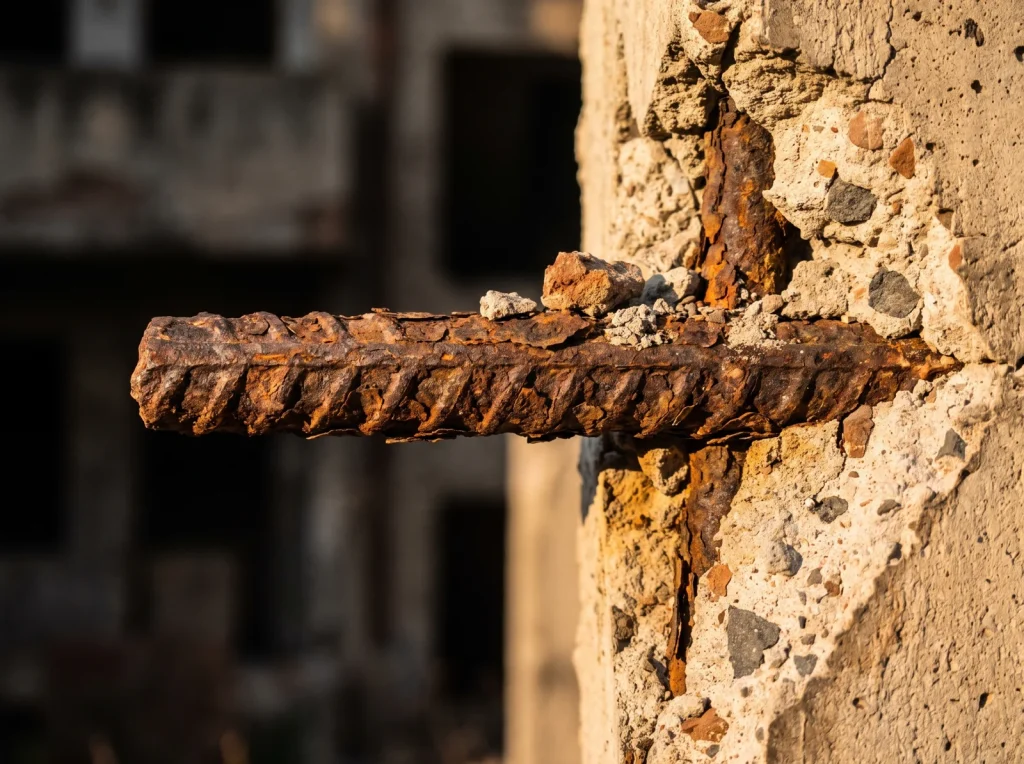
If you have ever wondered why does rebar rust in concrete when you live in one of the driest metros in the country, you are asking exactly the right question. Across Phoenix and the wider Arizona valley, homeowners watch their foundation stem walls crack, flake, and expose orange-brown steel — and they assume a desert climate should have protected them. It doesn’t, and the reason is more chemistry than weather. This guide explains the real mechanism behind rebar corrosion in Arizona and what actually stops it.
Isn’t the desert too dry for rust?
It is the most common assumption we hear, and it is wrong in a very specific way. Rust — iron oxide — needs three ingredients: iron, oxygen, and water. Arizona has no shortage of oxygen, your foundation is full of steel, and the “dry desert” only describes the air. It says nothing about the moisture sitting against the base of your stem wall after every irrigation cycle, every monsoon storm, and every night the soil wicks groundwater upward.
Corrosion does not care about your region’s average humidity. It cares about the moisture at one square inch of steel, right now. That is localized moisture, and in Arizona it is everywhere the average homeowner never looks: below grade, behind stucco, and along the concrete-to-soil line where drip lines and lawns dump water daily. A dry climate can still deliver a soaking-wet foundation footing. That contradiction is the whole story of rebar corrosion in Arizona.
The chemistry, in plain English
How concrete normally protects steel
Fresh concrete is strongly alkaline, with a pH around 12 to 13. At that high pH, a microscopically thin film forms on the surface of the embedded steel — engineers call it the passivation layer. Think of it as an invisible chemical shield. As long as it holds, the steel simply does not corrode, even though it is surrounded by the moisture and oxygen that rust needs. This is why a well-built, properly covered foundation can last for generations. The concrete is not just holding the rebar in place; it is actively keeping it chemically calm.
How chlorides and moisture break that protection
Two things dismantle that shield. The first is carbonation: carbon dioxide from the air slowly soaks into the concrete and drops its pH. Once the pH near the steel falls far enough, the passivation layer can no longer sustain itself. The second, and the bigger culprit in Arizona, is chloride ion attack. Chlorides — from salty soils, from hard tap water and softener discharge, from de-icing residue tracked in, and from certain aggregates — migrate through the concrete’s pore network dissolved in moisture. When enough chloride ions reach the steel, they punch through the passivation layer at tiny points and switch the corrosion process on.
Sulfates in Arizona’s soils add a second front. While chlorides go after the steel, sulfates attack the cement paste itself, opening it up so water and chlorides travel deeper and faster. The result is a foundation that is being undermined chemically from two directions at once — and none of it requires a humid climate to proceed.
The desert doesn’t protect your rebar. The concrete does — right up until chlorides and localized moisture break its chemical shield.
Why rust cracks concrete (the 6× expansion)
Here is the part that turns a chemistry problem into a structural one. When steel corrodes, it does not just weaken — it grows. Rust occupies far more volume than the original iron it came from, expanding by roughly six times as the metal converts to oxide. That expanding rust is trapped inside solid concrete, so it behaves like a slow, relentless wedge.
The pressure builds until the concrete can no longer contain it. First you see fine cracks running parallel to the buried rebar. Then the surface begins to delaminate, and chunks break away — the flaking, crumbling failure known as spalling. Once a piece pops off and exposes the bar, corrosion accelerates, because the steel now has direct access to air and water with no cover left at all. It becomes a feedback loop: rust cracks the concrete, the cracks admit more moisture, and more moisture makes more rust.
This is why concrete spalling on a stem wall is almost never a cosmetic issue. The flaking you can see is the downstream symptom of steel you cannot see doing exactly what expanding rust does. Understanding why does concrete spall comes down to that one fact: something inside it is getting bigger.
Older Arizona homes are especially vulnerable because of thin concrete cover. Cover is the depth of concrete between the outside face and the rebar, and it is the single biggest factor in how long the passivation layer survives. Where builders placed steel too close to the surface — common in decades-old construction — chlorides and carbonation reach it far sooner, and there is less material to resist the expansion when rust finally starts.
The Arizona moisture sources that start it
If localized moisture is the trigger, it helps to know where it actually comes from around a Phoenix home. In our field experience, the usual pathways are:
Get Your Foundation Looked At
A quick inspection tells you what is really going on beneath the surface — and we will send a written estimate.
→ Request a Written Estimate- Irrigation overspray and drip lines — sprinklers and emitters placed too close to the foundation soak the stem wall base every single cycle, often several times a week.
- Monsoon rain — brief, intense summer storms dump water against walls and footings faster than dry soil can absorb it.
- Poor drainage and negative grading — when soil slopes toward the house instead of away, water pools exactly where you least want it.
- Capillary rise — concrete and soil wick moisture upward from below grade, keeping the footing damp long after the surface looks bone dry.
- Salty water sources — hard tap water, water-softener discharge, and naturally chloride- and sulfate-rich soils deliver the ions that break the passivation layer.
Notice that none of these are rare or dramatic. They are the ordinary conditions of a landscaped Arizona yard. That is exactly why rusting rebar in a foundation is far more common here than the dry-climate reputation would suggest.
How to stop the cycle for good
Because the mechanism is a self-feeding loop, the fix has to break the loop rather than just hide it. Patching over spalled concrete without addressing the corroding steel underneath simply seals the problem in for a while — the rust keeps expanding and the patch fails. Genuine repair means removing the deteriorated concrete, treating or replacing the compromised steel, and restoring proper cover and protection so moisture and chlorides can no longer reach the reinforcement.
We approach this with proven techniques: stem wall repair that rebuilds the wall’s structural integrity, concrete spalling repair that removes and replaces failed material, and GFRP composite reinforcement — glass-fiber reinforced polymer that, unlike steel, does not corrode when exposed to chlorides and moisture. Anchor bolt retrofit and foundation crack repair round out the toolkit when the damage has spread to connections and the surrounding concrete. Reducing moisture at the source — moving irrigation back and improving drainage — is the homeowner’s half of a lasting fix.
The one thing you cannot do is diagnose corroding steel from a photo or a guess. Surface cracks reveal very little about how far the rust has progressed underneath. The only way to know the true condition of your reinforcement is to have someone look at it directly. If you are seeing flaking, cracking, or exposed metal on your stem walls, book an inspection and get a written estimate for exactly what your foundation needs. You can also read the practical walkthrough on how to fix spalling concrete stem walls before you decide.
Frequently Asked Questions
Why does rebar rust in concrete?
Rebar rusts when the concrete’s protective alkaline passivation layer breaks down, usually from chloride ions or carbonation lowering the pH around the steel. Once that shield fails, the moisture and oxygen already present in the concrete are free to corrode the iron, forming rust.
Does rebar rust in dry climates?
Yes. A dry climate only describes the air, not the moisture against your foundation. In Arizona, irrigation overspray, monsoon rain, poor drainage, and capillary rise keep steel locally wet, and salty soils and water supply the chlorides — so corrosion proceeds despite the desert reputation.
What is spalling and what causes it?
Spalling is the flaking, chipping, and breaking away of concrete from a surface. On Arizona stem walls it is most often caused by rebar corroding underneath: as the steel rusts and expands, it pushes the concrete apart from the inside until pieces crack and fall off.
How does rust cause concrete to crack?
Rust takes up roughly six times the volume of the original steel. Since the corroding rebar is locked inside solid concrete, that expansion acts like a wedge, building internal pressure that cracks the concrete along the bar and eventually forces surface pieces to delaminate and spall.
Can you stop rebar from rusting?
You can stop and prevent it, but not by patching over the surface. Lasting repair removes the deteriorated concrete, treats or replaces the compromised steel, restores proper cover, and cuts off the moisture source. Non-corroding options like GFRP composite reinforcement remove the rusting problem entirely. The essential first step is an inspection to see the actual condition of the steel.