
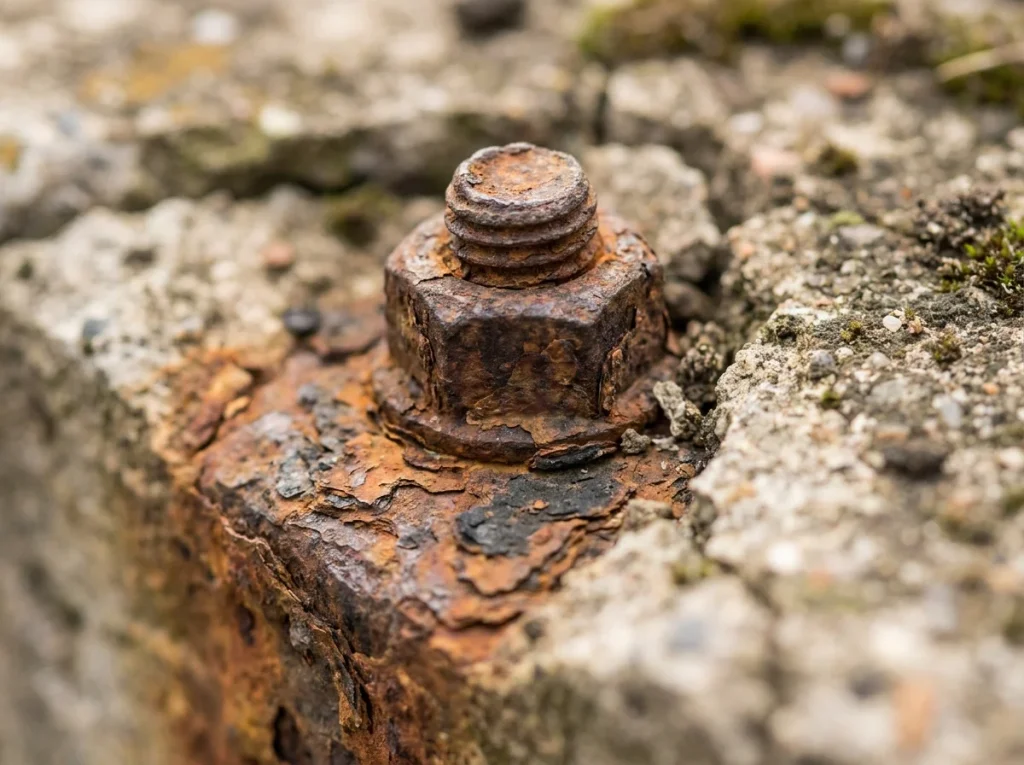
If you have found a rusted anchor bolt poking out of your Phoenix stem wall, your first thought is probably the obvious one: it’s dry here, so why do anchor bolts corrode at all? The short answer is that the desert air is not the problem — the water you put on your yard is. Flood irrigation, drip emitters, and monsoon runoff move moisture into the base of the concrete, and that is where corrosion begins. This Arizona guide explains the corrosion chain in plain terms, so you know what to look for and when to have it evaluated.
How a stem-wall anchor bolt is supposed to stay dry
The anchor bolt is the quiet workhorse of your home’s foundation-to-frame connection. On most Arizona homes it is a J-bolt anchor — an L- or J-shaped steel rod cast into the wet concrete of the stem wall when the foundation is poured. The threaded end passes up through the wood sill plate (or mudsill) and is clamped down with a washer and nut, tying the wood framing of your house to the concrete below.
For general context, the code baseline most builders follow (IRC R403.1.6) calls for anchor bolts typically at least ½ inch in diameter, embedded about 7 inches into the concrete, and spaced no more than 6 feet on-center. Done right, the top of the stem wall sits above grade, the sill plate stays dry, and the steel bolt lives its whole life inside dense, alkaline concrete. That high-pH environment forms a thin passive film on the embedded steel that keeps it from rusting. As long as the bolt and the rebar stay dry and buried in sound concrete, nothing corrodes — the trouble starts only when water finds a way in.
The Arizona moisture sources people overlook
This is the counterintuitive part. Homeowners assume corrosion is an East Coast problem — humidity, salt air, snow-melt chemicals — and figure the dry Valley keeps steel safe. But anchor bolt corrosion in a stem wall is driven by liquid water sitting against the base of the concrete, not ambient air, and Phoenix yards deliver that water in a few specific ways.
Flood irrigation and drip lines at the foundation
Large stretches of the Valley — Arcadia, parts of Mesa, Tempe, and older Phoenix neighborhoods — still run on flood irrigation. Every couple of weeks the yard is filled with several inches of standing water, and if the grade slopes toward the house or the stem wall sits low, that water pools against the concrete for hours. Drip systems are just as guilty on a smaller scale: emitters placed along the foundation to feed a hedge or flower bed put a slow, repeated dose of moisture exactly where you least want it. Multiply a short soak by years of watering cycles and the base of the stem wall is rarely fully dry.
Monsoon splash-back and poor drainage/grading
Then comes monsoon season. Heavy July and August storms dump water fast, and if your grading is flat or negative, it sheets toward the foundation instead of away. Roof runoff with no gutters lands at the drip line and splashes back onto the lower stem wall. Add our native caliche soils — a hard, calcium-carbonate hardpan that drains poorly — and water that should percolate away instead lingers below the surface, holding moisture against the buried concrete for days. A telltale sign is efflorescence: the chalky white crust that appears as moisture wicks through the concrete and leaves mineral salts on the surface.
The corrosion chain: moisture → rebar spalling → exposed bolt
Here is how those water sources turn into a rusted bolt and crumbling concrete — a chain where each link worsens the next:
- Moisture ingress. Water — carrying dissolved minerals and sometimes chlorides from soil and irrigation — soaks into the porous concrete and reaches the embedded steel.
- Loss of protection. As moisture and carbonation reach the steel, the protective alkaline film breaks down and the rebar and anchor bolt begin to rust.
- Rebar corrosion and expansion. Rusting steel expands to several times its original volume, pushing outward from inside the wall with real force.
- Concrete spalling. The expanding rust cracks the surrounding concrete and pops off the cover protecting the steel. This is spalling: flaking, cracking, and chunks breaking away, usually along the lower stem wall or around the bolt.
- Exposed bolt. Once the cover is gone, the bolt and rebar meet air and water directly. Corrosion speeds up, the bolt thins, and the foundation-to-frame connection weakens.
The key point is that stem wall spalling and anchor-bolt corrosion are the same story at different stages. The rusting steel is what spalls the concrete; the spalled concrete is what leaves the steel exposed. That is why the two are almost always found — and repaired — together. We cover the concrete side in depth in why rebar rusts and spalls in Arizona.
It’s not the desert air that rusts your anchor bolts — it’s the water you put on your yard finding its way to the steel inside the concrete.
How to spot early warning signs before the bolt fails
You do not need to wait for a structural problem to catch this early. A slow walk around your foundation twice a year tells you most of what you need to know. Look along the lower stem wall, especially on the sides that face irrigation, drip beds, or downspouts, and watch for:
- Rust staining — orange or brown streaks bleeding down the concrete, often the first visible clue that steel inside is corroding.
- Efflorescence — the white chalky powder that signals moisture has been moving through the wall.
- Spalling and flaking — concrete that is cracking, bubbling, or breaking away, particularly near the base or around a bolt.
- An exposed or visibly rusted anchor bolt — steel where concrete used to cover it, or a bolt that looks pitted and scaled.
- A loose or corroded nut and washer at the sill plate, or wood staining or softness at the mudsill.
None of this means panic — a single stained bolt is not a collapsing house. But these signs are worth a professional look before the spalling spreads and more bolts lose their cover. To understand what you are seeing, what concrete spalling on a stem wall actually is walks through it in detail, and when you are ready you can book an inspection.
Get Your Foundation Looked At
A quick inspection tells you what is really going on beneath the surface — and we will send a written estimate.
→ Request a Written EstimateWhat corrosion means for the fix (and why spalling gets repaired too)
Because the rusted steel and the damaged concrete are one connected problem, the repair addresses both. A proper stem wall repair starts by assessing how far the corrosion and spalling have progressed, then follows a sequence: remove the failed, delaminated concrete back to sound material; clean and treat the corroded rebar and bolt, or supplement them where the steel has lost too much section; and rebuild the cover so the steel is protected again.
On the anchorage itself, if a bolt is too far gone, the downstream fix is an epoxy anchor or retrofit tie — a new anchor set into sound concrete with structural epoxy to restore the foundation-to-frame connection the IRC anchorage requirements call for. In some cases GFRP composite reinforcement (a non-corroding glass-fiber reinforcement) strengthens the wall without adding new steel that could rust later. The right combination depends on what the inspection finds. For the concrete side, how to fix spalling concrete stem walls lays out the process.
The goal is always the same: stop the moisture source, restore the steel’s protection, and put the foundation-to-frame connection back to work.
Frequently Asked Questions
What causes anchor bolts to rust in a dry climate like Arizona?
It is liquid water, not the dry air. Flood irrigation, drip emitters, monsoon runoff, and poor grading push moisture into the porous concrete, where it reaches the embedded steel, breaks down the alkaline film that protects it, and the bolt begins to rust — even in a dry climate.
Does irrigation cause foundation and anchor-bolt corrosion?
It is one of the most common causes in the Valley. Flood irrigation puts inches of standing water against the stem wall on a cycle, and drip lines along the foundation deliver a steady, repeated dose of moisture. Over years, that keeps the base of the concrete damp and drives the corrosion chain behind rusted bolts and spalling.
Why is the concrete spalling around my anchor bolt?
Because the steel inside is rusting. When rebar or a bolt corrodes, the rust expands to many times the steel’s original volume and pushes outward, cracking and popping off the concrete cover. So the spalling around a bolt is usually the visible result of corrosion just beneath the surface.
Is anchor-bolt corrosion a sign of a bigger foundation problem?
It can be, which is why it is worth evaluating. Often it is localized to one wet zone of the yard, but corrosion and spalling can spread along a wall and weaken the foundation-to-frame connection over time. An inspection tells you whether it is contained or part of a larger pattern.
How do I stop my stem wall from spalling?
First, cut off the moisture: move drip lines and sprinkler spray away from the foundation, improve grading so water drains away, and manage roof runoff. Then have the damaged concrete removed, the corroded steel treated or supplemented, and the cover rebuilt. Stopping the water source is what keeps the repair from coming back.
Can a corroded anchor bolt be saved or does it need replacing?
It depends on how much steel is left. A lightly rusted bolt in otherwise sound concrete can often be cleaned, treated, and protected. A bolt that has lost significant cross-section is usually retrofitted — a new epoxy anchor or tension-tie set in sound concrete to restore the connection. An inspection determines which path your bolt needs.