
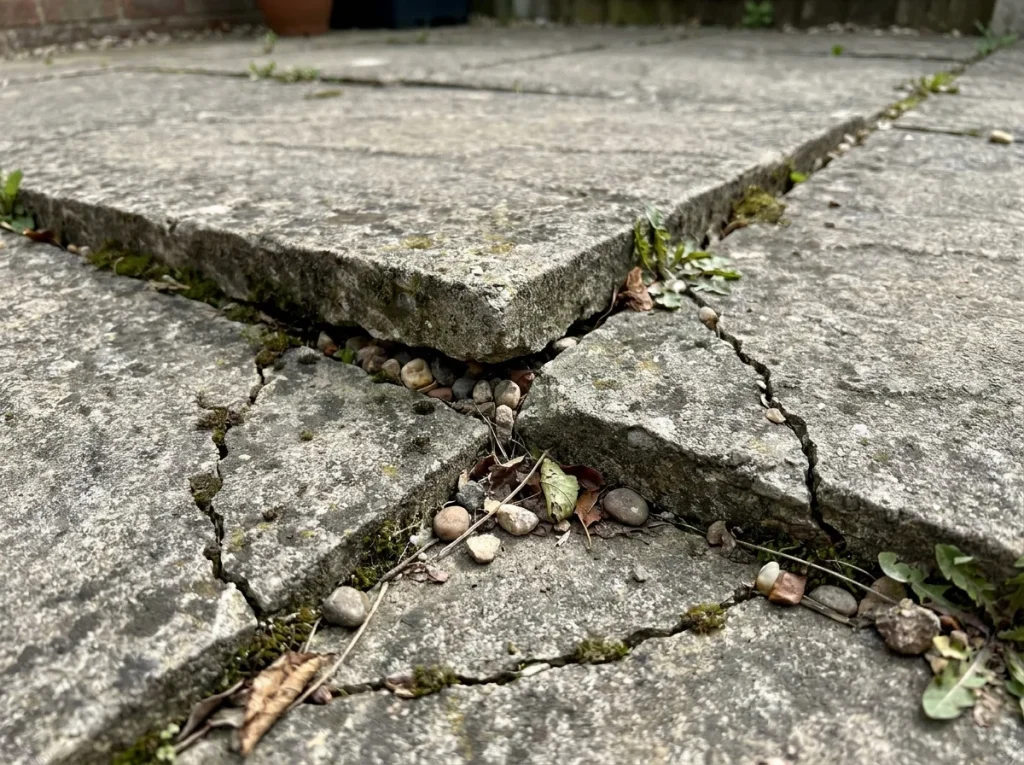
If your driveway, patio, or garage slab has dropped an inch or two, the question isn’t really “leveling or replacement” — it’s whether the concrete underneath the crack is still sound. In most Phoenix and greater Arizona homes, concrete leveling is worth it: it’s faster, cheaper, and less disruptive than tearing out a slab, and it’s the repair method we use most often on sunken flatwork. But leveling only works when the slab itself is still structurally sound — and knowing the difference is what separates a repair that lasts from a $3,000 mistake.
The quick decision rule
Here’s the short version, before we get into the numbers. If the slab is intact — no major cracking, no crumbling edges, no rebar showing — and it’s simply sunk or tilted because the soil underneath settled, leveling is almost always the right call. It costs a fraction of tear-out, and it’s done in an afternoon instead of a week. If the slab is broken into pieces, spalled down to the aggregate, or thinner than it should be from the start, no amount of foam or grout fixes that — replacement is the honest answer. Everything below explains how to tell which situation you’re actually in, and why the soil under your feet matters more than the concrete on top of it.
When leveling is the smart, cheaper choice
Concrete leveling — whether it’s done with polyurethane foam injection or traditional mudjacking (pumping a cement-based slurry underneath the slab) — raises an existing slab back to grade by filling the void that formed when soil settled or washed out beneath it. Nothing about the slab itself changes; it’s lifted, supported, and leveled in place. For sunken driveways, patios, sidewalks, pool decks, and garage floors that are otherwise in good shape, this is the repair that gets the most value per dollar.
Cost — leveling vs. tear-out and repour
Cost is where the decision usually gets made. Leveling typically runs somewhere between $3 and $25 per square foot depending on the method and how much lift the slab needs — self-leveling compounds sit at the low end ($1–$6/sq ft), mudjacking runs $3–$9/sq ft, cement slurry injection $6–$15/sq ft, and polyurethane foam $5–$25/sq ft, with most residential jobs landing around $1,200 on average. Full replacement means demolition, haul-off, forming, rebar or wire mesh, a new pour, and a multi-week cure — and that adds up to several times the cost of leveling for the same square footage, before you even account for disposal fees or extra work if utility lines run under the slab.
Downtime — foam cures in minutes vs. days for new concrete
The other half of the “is it worth it” question is how long you’re locked out of the space. Polyurethane foam sets in about 15 minutes and can typically bear full weight the same day — a leveled driveway or garage floor is usable again almost immediately. Mudjacking slurry needs a bit more time to firm up, usually a day or so before heavy traffic. A newly poured slab, by contrast, needs days to cure before foot traffic and closer to a full month before it can safely handle a parked vehicle. If you’re trying to get a driveway or garage back in service without weeks of orange cones and detours, that gap alone often settles the decision.
When replacement is actually the right call
Leveling raises and stabilizes concrete — it doesn’t repair concrete that’s already broken. A good contractor will tell you when that line has been crossed, even if leveling would be the easier sale.
Severe cracking, spalling, or crumbling
If a slab has multiple structural cracks running through it, has separated into distinct sections that move independently, or is spalling and flaking down to exposed aggregate or rebar, injecting foam or grout underneath won’t hold it together. You’d be lifting a slab that’s already failing, and it will crack further, or fail again, under normal use. At that point, replacement isn’t overkill — it’s the only repair that actually resets the clock.
Slab thickness and structural damage
Some slabs were simply poured too thin, without adequate rebar or wire mesh, or without proper base preparation to begin with — common on older Phoenix-area homes and additions. A thin, under-reinforced slab can be lifted level, but it’s still a thin, under-reinforced slab, and it will crack again under vehicle weight or the next round of soil movement. If an inspection turns up structural undersizing rather than simple settlement, replacing with a properly thickened, reinforced pour is the repair that’s actually worth paying for.
The Arizona factor — soil and drainage decide durability either way
This is the part most homeowners never get told, and it’s the single biggest factor in whether either repair lasts: in Phoenix and across the Valley, expansive clay soil swells when it gets wet and shrinks hard when it dries out. Add a monsoon season that dumps water fast, poor grading, or a leaking irrigation line near the foundation, and that soil cycles through repeated expansion and contraction under the slab every year. That movement — not the age of the concrete — is what causes most sunken driveways, patios, and garage floors in the first place.
Replacing a slab without fixing the drainage or soil movement that sank it in the first place doesn’t solve anything — it just buys you a brand-new slab that sinks on the same schedule as the old one.
That’s why the value question isn’t really “leveling vs. replacement” in the abstract. It’s “will the cause be addressed either way?” A leveled slab on stable, well-drained soil can hold its position for years. A brand-new slab poured over the same drainage problem that sank the original one is on borrowed time. Whichever repair you choose, ask what’s being done about the soil and water — not just the concrete.
How an inspection settles the question (what we look for)
Because the right answer depends on the slab’s condition and the cause underneath it, this isn’t something to guess at from a photo. When we evaluate a sunken or uneven slab, the process looks at the whole picture: how much the slab has settled and in what pattern, whether cracking is cosmetic or structural, slab thickness and reinforcement where it can be assessed, drainage and grading around the affected area, and any signs of ongoing soil movement nearby, including cracks or gaps at the foundation itself. We bring that same honesty to every evaluation — telling homeowners the truth about what a slab actually needs, not just what’s easiest to sell.
Get Your Foundation Looked At
A quick inspection tells you what is really going on beneath the surface — and we will send a written estimate.
→ Request a Written EstimateThat inspection ends with a written estimate that lays out the recommended repair, the method, and the reasoning — not a guess and not a hard sell. If leveling will hold, that’s what gets recommended. If the slab is too far gone, that gets said plainly too, along with what replacement realistically costs for the space involved.
A rough cost/longevity comparison
To put the two options side by side for a typical residential slab:
- Concrete leveling: roughly $3–$25 per square foot depending on method and lift required (average around $1,200 for a typical job); usable same-day to next-day; best suited to sound slabs with simple settlement.
- Full tear-out and replacement: several times the per-square-foot cost of leveling once demolition, haul-off, forming, reinforcement, and a new pour are included; typically days to weeks before full use; necessary when the slab is structurally compromised.
- Longevity in either case: determined less by the repair method and more by whether the underlying soil movement and drainage issue was corrected — an unaddressed cause will eventually undermine a new slab just as it did the old one.
Frequently Asked Questions
Is it cheaper to level or replace concrete?
Leveling is almost always cheaper. It runs roughly $3–$25 per square foot depending on the method, versus several times that for full demolition, forming, reinforcement, and a new pour. Cost only tips toward replacement when the slab is too damaged for leveling to hold, which then makes replacement the only repair that will actually last.
Is concrete leveling worth the money?
For a slab that’s sound but has settled or sunk, yes — leveling restores a level, safe surface for a fraction of replacement cost and with almost no downtime. It’s not worth the money on a slab that’s already cracked apart or crumbling, because lifting broken concrete doesn’t fix the break.
When should you replace concrete instead of leveling it?
Replace instead of level when the slab has multiple structural cracks, is spalled or crumbling down to the aggregate or rebar, was poured too thin or under-reinforced to begin with, or has separated into sections that move independently of each other. In those cases, leveling would only be lifting concrete that’s already failing.
How much does concrete leveling cost vs. replacement?
Leveling methods range from about $1–$6/sq ft for self-leveling compounds up to $5–$25/sq ft for polyurethane foam injection, with mudjacking and slurry methods in between; most residential jobs average close to $1,200 total. Full replacement adds demolition, disposal, forming, and reinforcement on top of the concrete pour itself, which typically puts it at several times the leveling cost for the same area.
Does leveling last as long as new concrete?
It can, if the cause of the original settlement has been addressed — leveling doesn’t wear out the way concrete ages, it stays lifted as long as what’s underneath it stays stable. What determines longevity in either case is the soil and drainage, not whether the slab is old concrete that’s been releveled or brand-new concrete.
Will a new slab sink again on the same soil?
Yes, if the expansive soil, poor grading, or drainage issue that caused the original settlement isn’t corrected. A new pour over an unresolved drainage problem is exposed to the same soil movement as the slab it replaced, and it will settle on a similar timeline.
How do I know if my slab is too far gone to level?
The clearest signs are multiple structural cracks (not just hairline surface cracks), sections of slab that rock or move independently, spalling that exposes aggregate or rebar, or a slab that feels notably thin at the edges. Short of visible damage, a physical inspection is the only reliable way to confirm whether leveling will hold or whether the repair won’t last — which is why it’s worth getting a written estimate before committing to either option.