
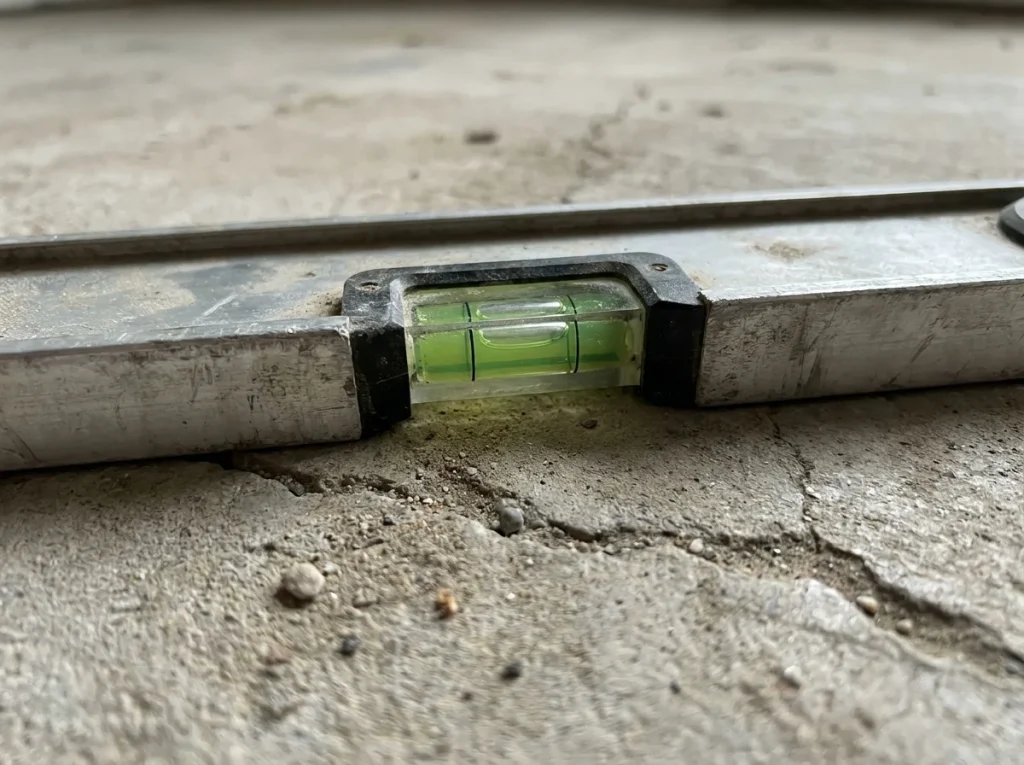
A marble that rolls to the same corner of every room, a door that used to close fine and now sticks halfway — these are the small tells behind a bigger question: what causes sloping floors? In most Phoenix, Arizona homes built on a slab, the answer isn’t the house “settling normally.” It’s the concrete slab itself moving, and that’s the kind of structural issue we’re called in to diagnose and fix. Here’s what an uneven floor is actually telling you, how much slope is normal versus concerning, and what fixes it — and what doesn’t.
What an uneven floor is usually telling you
Homes built on a raised foundation with a crawlspace can develop a sagging or bouncy floor because of rotting or undersized floor joists — a framing problem, not a foundation one. That’s a common cause in wetter, older-housing-stock climates. Phoenix is different. The overwhelming majority of homes here sit on a slab-on-grade foundation, poured directly on the soil with no crawlspace underneath. There’s no joist to rot. So when a slab-on-grade floor tilts, dips, or feels off underfoot, the far more likely explanation is that the slab itself has moved — usually because the soil supporting part of it has shifted, shrunk, or washed out. That’s a structural issue, not a cosmetic one, and it’s why a sloping floor in a Phoenix home deserves an actual inspection rather than a shrug.
The common causes in Phoenix homes
Settlement and heave
Two opposite movements produce the same symptom. Differential settlement happens when one section of the slab sinks lower than the rest, usually because the soil beneath it has compacted, eroded, or lost volume — this is the classic cause of a sinking foundation. Heave is the reverse: expansive clay soils absorb moisture and swell, pushing a section of slab upward. Either way, the problem is “differential” — it’s not that the whole house dropped evenly (which would barely be noticeable), it’s that one part moved relative to another, and that’s what your foot picks up as a slope. Whether a home was built on a post-tension slab or over a stem wall foundation changes how that movement shows up and how it’s repaired, which is part of why we look at the foundation type first during an inspection.
Soil voids, moisture, and leaks
Underneath a slab, the soil is supposed to be uniformly compacted. It doesn’t stay that way forever. Valley heat and clay-heavy soils cause repeated swell-shrink cycles that open small voids under the concrete. A slow slab leak, a broken irrigation line, or water pooling against the foundation after a monsoon can wash fines out from under the slab or oversaturate the soil on one side of the house. Poor drainage and grading that slopes water toward the foundation instead of away from it does the same thing over years, not weeks. In most cases it isn’t one dramatic event — it’s a slow loss of support under one section of concrete until that section finally gives a little, and the floor tells on it.
How much slope is actually a problem (the numbers)
Not every uneven floor is an emergency, and not every older Phoenix home needs releveling. Foundation professionals typically use an elevation survey — a floor-level reading taken in a grid across the slab — to measure how much a floor has moved, expressed in inches of rise or fall over a given distance.
As a general rule we use in the field: roughly 1 inch of differential movement over a 15 to 20 foot span is when a slab is considered to have measurable structural settlement worth addressing. A home built decades ago with a small amount of old, stable variation is a different conversation than a floor that’s actively moving.
What matters more than the raw number is whether the movement is old and stable or active and ongoing. A floor that’s been slightly off for 20 years with no new cracking is a very different situation from one that’s visibly changed in the last six months. An elevation survey during a foundation inspection establishes a baseline, so if there’s ever a question later, you have a number to compare against — not just a feeling that “it seems worse.”
Other signs that appear alongside it
A sloping floor rarely shows up completely alone. Watch for these related signs, which usually point to the same underlying cause:
- Interior or exterior cracks in the slab, drywall, or block wall — especially diagonal cracking near door and window corners (see our guide to foundation crack repair for what different crack patterns mean)
- Doors and windows that stick, won’t latch, or have gaps that weren’t there before
- Visible gaps between the baseboard and the floor, or between the floor and interior walls
- Tile grout lines cracking in a consistent direction
- A soft, bouncy, or springy feeling underfoot in one area — often confused with structural settlement, but on a slab this is more commonly a subfloor or flooring-installation issue rather than the concrete itself moving
Any one of these on its own isn’t necessarily alarming. Several of them together, in the same part of the house, is the pattern worth having someone look at. We cover the full list of what to watch for in 7 warning signs your Phoenix home has a foundation problem.
Get Your Foundation Looked At
A quick inspection tells you what is really going on beneath the surface — and we will send a written estimate.
→ Request a Written EstimateHow it’s fixed (leveling vs. underpinning)
The right fix depends entirely on what’s happening under the slab, which is why guessing from the symptom alone is a bad idea. For settlement caused by soil voids or minor differential movement, concrete leveling — raising and stabilizing the slab back toward its original position — is often the appropriate repair, sometimes paired with carbon fiber reinforcement to stop existing cracks from progressing. For more significant or ongoing settlement, the industry term is “underpinning” — a broader category of deep-foundation support methods. It’s a real distinction worth knowing, but it also means the correct approach genuinely varies by case: what’s appropriate for one Phoenix home’s soil and slab type isn’t automatically right for the next one. That’s why every job starts the same way, with a proper foundation inspection and a written estimate that lays out exactly what’s moving, why, and what it takes to stabilize it — never a one-size-fits-all fix. For the full picture of causes, costs, and repair options specific to floors, see our uneven floor repair page.
Frequently Asked Questions
What causes sloping floors?
In a Phoenix slab-on-grade home, sloping floors almost always trace back to the soil beneath the concrete — either settlement (soil compacting, eroding, or losing volume under one section of the slab) or heave (expansive clay swelling with moisture and pushing part of the slab up). Voids from swell-shrink cycles, slab leaks, and poor drainage around the foundation are the usual drivers.
Are uneven floors always a sign of foundation problems?
Not always, but on a slab-on-grade home the odds are higher than most homeowners assume. Since there’s no crawlspace or joists to blame, a sloping floor generally points back to the slab and the soil under it rather than a framing defect. A small, old, and stable variation in an older home is different from new or worsening movement — an elevation survey during an inspection is how you tell the two apart.
How much floor slope is normal?
There’s no perfectly flat house, and a small amount of long-standing, stable variation is common in older homes. As a general benchmark, roughly 1 inch of differential movement over a 15 to 20 foot span is where professionals start to consider a slab to have measurable structural settlement. What matters most is whether the movement is old and stable or new and active.
Why is my floor bouncy or springy?
A bouncy or springy feeling is more often tied to the flooring installation or subfloor than to the concrete slab itself moving — but it’s still worth mentioning during an inspection, especially if it shows up in the same area as sloping, cracking, or sticking doors, since that combination points toward slab settlement rather than a flooring issue.
When should I worry about a sloping floor?
Worry less about the slope itself and more about whether it’s changing. New cracks, doors that recently started sticking, gaps opening at baseboards, or a slope you can visibly measure getting worse over months are the signals that mean it’s time for a written estimate rather than a wait-and-see approach.
Can sloping floors be fixed, and how much does it cost?
Yes — concrete leveling, crack repair, and carbon fiber reinforcement address the vast majority of sloping-floor cases caused by slab settlement, restoring both the floor and the slab’s structural integrity. Cost depends on the extent of settlement, the area affected, and the repair method needed, which is exactly what a foundation inspection is for. See what affects foundation repair cost for a breakdown, or contact us to book an inspection and get a written estimate for your specific floor.