
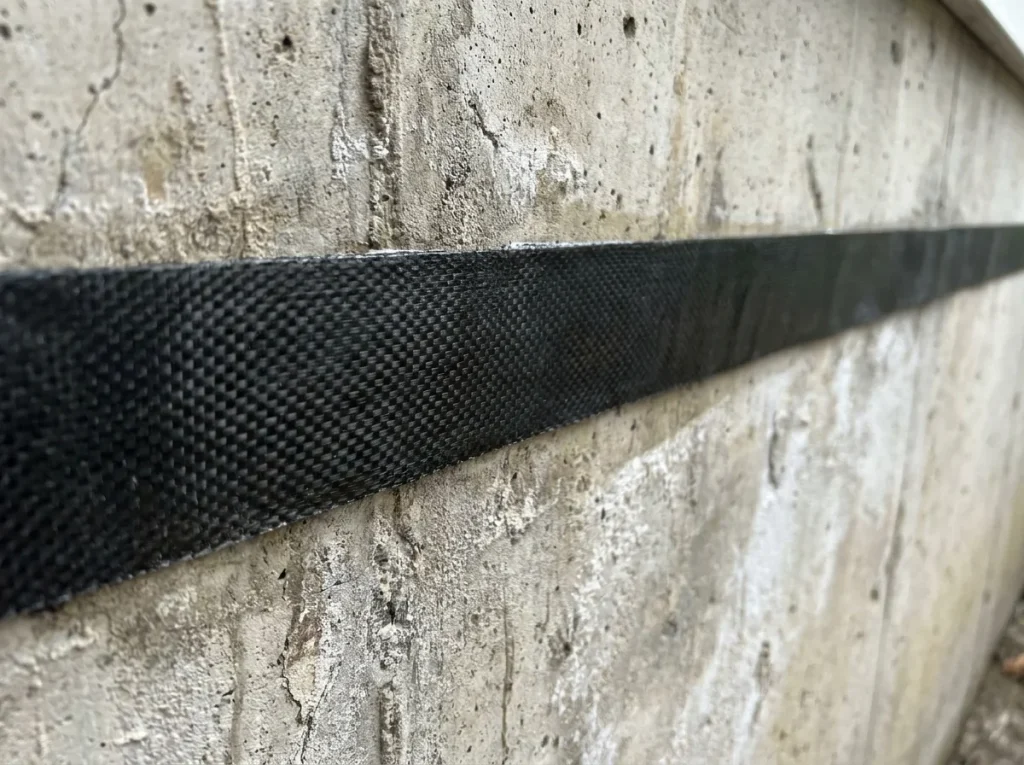
The carbon fiber staple or strip bonded across a crack won’t rust, won’t rot, and won’t stretch — so how long does carbon fiber foundation repair last? On its own, the material can easily outlast the house it’s installed in. But in Phoenix, the honest answer depends less on the carbon fiber itself and more on how the job was diagnosed and installed. Every carbon fiber reinforcement repair we perform is only as durable as the epoxy bond underneath it and the movement it was designed to stop.
Why carbon fiber itself lasts (no rust, no stretch)
Carbon fiber is a manufactured composite, not a metal, which is why it behaves so differently from the materials it’s replacing. Steel rebar and wire mesh can corrode over time, and rusting steel actually expands inside concrete, which is a common cause of new cracking years after the original pour. Carbon fiber doesn’t oxidize, so that failure mode simply isn’t in play. It also doesn’t creep or elongate under sustained load the way some strapping systems can, which matters on a slab-on-grade foundation where a crack needs to be held at a fixed width, not just slowed down.
In Arizona’s slab-on-grade construction, that translates into carbon fiber staples and stitches applied directly across slab and stem wall cracks, plus carbon fiber rebar in some reinforcement scopes — a different application than the bowing-basement-wall straps most national articles on this topic are actually describing. As a material, carbon fiber’s working lifespan is measured in decades, not years. The question homeowners should really be asking isn’t whether the fiber will hold up — it’s whether the installation will.
The bond is what really matters
Carbon fiber only reinforces what it’s bonded to. The epoxy saturating the fiber and gluing it to the concrete is doing the actual work of transferring load, and that bond is only as good as the surface it was applied to. Concrete that’s spalled, delaminating, or holding moisture won’t accept a durable bond no matter how strong the carbon fiber itself is — which is why a repair that skips proper surface prep, moisture checks, and correct epoxy saturation can look fine on day one and start lifting within a few years.
This is also why a crack repair and a bond-quality problem can look identical from the outside but have completely different causes. If the concrete under a strap or staple was compromised before installation — from spalling or deterioration — the fix needs to address that surface first. Skipping that step is the single most common reason a carbon fiber repair underperforms its material lifespan.
Carbon fiber doesn’t fail. Bad bonds and uncontrolled movement do.
“Permanent” — only if the cause is controlled
Carbon fiber reinforcement stabilizes a crack against further widening; it doesn’t, by itself, stop the soil movement that opened the crack in the first place. Phoenix-area foundations move for identifiable reasons — expansive clay, moisture cycling around the perimeter, poor drainage, or active settlement — and if that cause keeps operating, new movement can show up as a fresh crack nearby even with a perfectly bonded repair in place. That’s why “permanent” is the right word only once the underlying cause has been controlled, not just the symptom that was visible on the wall.
This is also where carbon fiber and other repair methods aren’t interchangeable, and it’s worth understanding what a proper crack repair actually involves before assuming reinforcement alone is enough. If an inspection turns up active settlement rather than a stable crack, the scope may need to include concrete leveling or address foundation settlement directly — carbon fiber reinforces sound concrete, it doesn’t correct a foundation that’s still moving underneath it. For a side-by-side look at when reinforcement alone is appropriate versus when a different repair method is needed, see our comparison of carbon fiber versus other structural repair approaches.
Warranty and what it covers
Because the fiber itself is effectively maintenance-free, the meaningful warranty on a carbon fiber repair is really a warranty on the installation — the bond, the surface prep, and the workmanship behind it. We back our carbon fiber reinforcement work with a written estimate up front and a workmanship warranty on the installation, so homeowners aren’t guessing about what’s covered. That track record is built on repairs that were bonded correctly the first time, not just sold aggressively.
Get Your Foundation Looked At
A quick inspection tells you what is really going on beneath the surface — and we will send a written estimate.
→ Request a Written EstimateWhat a workmanship warranty typically won’t cover is new movement from a cause that wasn’t part of the original scope — which is exactly why an accurate diagnosis matters more than the material spec sheet. If you’re unsure whether a crack is stable or still active, a foundation inspection is the way to find out before reinforcement goes on the wall.
Frequently Asked Questions
How long does carbon fiber foundation repair last?
The carbon fiber material itself can last decades without corroding, stretching, or degrading. The repair as a whole lasts as long as the epoxy bond holds and the cause of the original movement stays controlled — properly installed, that’s effectively the life of the structure.
Is carbon fiber a permanent fix?
It’s permanent for the crack it’s applied to, provided the surface was properly prepped and the underlying movement has stopped. It isn’t a permanent fix for active settlement or ongoing soil movement — that requires addressing the cause, not just reinforcing the symptom.
Do carbon fiber straps come loose?
The fiber itself won’t loosen, but the epoxy bond beneath it can fail if it was applied to damp, dirty, or deteriorated concrete, or if it wasn’t fully saturated during installation. When a carbon fiber repair fails prematurely, it’s almost always a bond or prep issue, not a defect in the fiber.
What warranty comes with carbon fiber repair?
We provide a written estimate before work begins and stand behind the installation with a workmanship warranty. Coverage applies to the quality of the bond and installation, not to new movement from a cause outside the original repair scope.
Does carbon fiber degrade over time?
No — carbon fiber doesn’t rust, rot, or break down from moisture the way steel reinforcement can. The material’s lifespan isn’t the limiting factor in a carbon fiber repair; the bond and the surrounding concrete are.