
If two contractors looked at the same crack and one quoted carbon fiber while the other quoted piers, you’re not imagining a scam — you’re looking at two different diagnoses. Carbon fiber vs. piers is one of the most confusing decisions a Phoenix, Arizona homeowner runs into, because the methods solve two different problems: one stops a wall from moving, the other supports and sometimes lifts a footing that’s already sinking. This guide walks through exactly how to tell which repair — if either — your home actually needs.
They fix two different problems
Before you compare price tags, compare purposes. Carbon fiber and piers aren’t competing versions of the same fix — they’re tools for two separate failure modes, and using the wrong one either wastes money or leaves the real problem untouched.
Carbon fiber = wall stabilization (stop the movement)
Carbon-fiber reinforcement is a tension material — straps, laminate strips, or staples/stitches bonded to concrete or masonry to resist further cracking and movement. It doesn’t lift anything and it doesn’t add support underneath a footing; it holds a wall or slab section in its current position and keeps a crack from widening. That makes it the right call for cracks that are stable in width, minor bowing, and the kind of stress cracking that shows up in stem walls and slab edges. It’s also the less invasive, lower-cost option, since there’s no excavation and no hydraulic lifting involved — see our carbon fiber reinforcement page for how it’s applied.
Nationally, most articles describe carbon fiber as basement wall straps. Phoenix doesn’t have basements — homes here are built slab-on-grade, so the more common application is carbon-fiber staples or stitches over cracked slab and stem-wall sections, sometimes paired with carbon-fiber rebar. Same material, different construction, different install. We cover that in more detail in does carbon fiber foundation repair actually work.
Piers = underpinning (support and sometimes lift the footing)
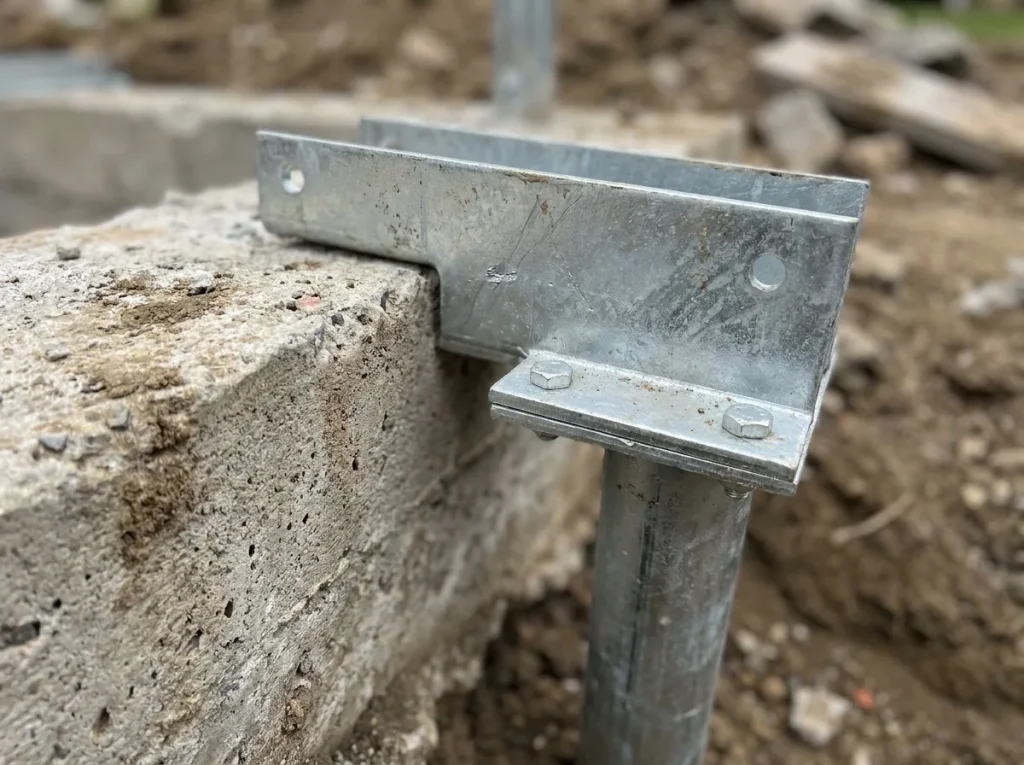
Helical and push (resistance) piers are an underpinning method: steel shafts driven or screwed down to stable, load-bearing soil, then connected to the footing to transfer the structure’s weight off soil that’s failing. Because piers reach a stable bearing depth, they can, in some cases, also lift a settled corner back toward level. That’s a fundamentally different job than stabilizing a wall — piers address a foundation that’s losing vertical support, not a crack that’s simply telling you concrete has stress in it.
How to tell which one your home needs
The symptoms usually point one direction before a single tool touches your house. Here’s the split most homeowners can spot on their own, though a proper diagnosis still needs an eye on-site.
Signs that point to carbon fiber
- Diagonal or stair-step cracks in a stem wall or block foundation
- Hairline to moderate cracks that appear stable in width over time
- Slight inward bowing of a wall (generally under an inch or two) with no accompanying sinking
- Cracking without doors or windows sticking, and without a sloping floor nearby
Signs that point to piers
- A visibly sinking or dropped corner of the house
- Floors that noticeably slope toward one side of the home
- Doors and windows racking out of square or refusing to latch
- Wide gaps opening up between the foundation and exterior brick, siding, or a porch slab
- Cracks that keep growing wider month over month, not just sitting there
If your symptoms line up with a settling or sinking foundation rather than a stationary crack, start with our foundation settlement repair and sinking foundation repair pages — those cover what an actual settlement diagnosis looks like before anyone talks about underpinning.
Cost comparison (and why the cheap option isn’t always right)
Cost is where most homeowners start the comparison, and it’s the wrong place to start. But the numbers still matter once you know which problem you have. A single crack repaired with carbon-fiber staples or stitches often runs in the $200–$300 range per repair. A fuller wall stabilization job using continuous carbon-fiber straps typically runs $3,000–$8,000, or roughly $15–$40 per linear foot of wall treated. Pier systems, because they involve excavation, steel shafts driven to bearing depth, and structural connection to the footing, typically run $5,000–$15,000 or more depending on how many piers a foundation needs.
Choosing carbon fiber because it’s cheaper, when the real problem is a sinking footing, doesn’t save money — it delays a repair that gets more expensive the longer settlement continues. And choosing piers when a wall just needs stabilization means paying for excavation and underpinning a foundation that was never losing vertical support in the first place. There’s also a middle option worth knowing about: if a slab section has settled slightly but the foundation itself is stable, concrete leveling can sometimes raise it back closer to level without full underpinning at all. The right question was never “which is cheaper” — it’s “which problem do I actually have.”
The Arizona wrinkle — settlement vs. heave vs. a stable crack
Phoenix sits on expansive soil that swells when it absorbs moisture and shrinks as it dries out. That cycle causes two very different movements that get lumped together in homeowner conversations: settlement, where soil compresses or washes out and the foundation sinks, and heave, where soil expands and pushes a section of foundation upward. Piers are engineered to address settlement — they anchor to stable soil below the active zone to stop or reverse sinking. They don’t correct heave, because heave is an upward force problem, not a lack of support problem. Treating a heave-related crack as if it were settlement can mean paying for underpinning that doesn’t touch the actual cause.
Then there’s the third category: a crack that’s neither settling nor heaving, just ordinary curing and thermal stress in concrete, which is extremely common in Phoenix’s slab-on-grade construction and heat swings. That kind of crack usually just needs carbon fiber or a standard crack repair, not a structural intervention at all. Sorting settlement from heave from a stable crack is exactly the kind of call that shouldn’t be made from a photo or an article — it needs eyes and instruments on the actual soil and slab.
Get Your Foundation Looked At
A quick inspection tells you what is really going on beneath the surface — and we will send a written estimate.
→ Request a Written EstimateWhy a real inspection settles the debate faster than any article
No blog post can measure your slab or watch a crack over the next six months — that’s a job for someone standing in the house with a level and a moisture meter. We treat diagnosis as the actual product, not a formality before an upsell.
We don’t sell a pier system to fix a crack that a $300 carbon-fiber stitch would solve — and we won’t sell carbon fiber to a homeowner whose footing genuinely needs underpinning. The diagnosis comes first, every time.
If an inspection shows your home needs support beyond stabilization or leveling, that’s a conversation for a structural engineer and a piering specialist — piers aren’t something we do, and an honest inspector tells you that instead of quietly scoping a job outside their own expertise. If the diagnosis points to stabilization, leveling, or crack repair, that’s exactly the work we do. Either way, you walk away with an accurate answer instead of a guess. Start with a foundation inspection and book an inspection before either method gets applied to your home.
Frequently Asked Questions
What is the difference between carbon fiber and piers?
Carbon fiber is a tension-resistant reinforcement bonded to existing concrete or masonry to stop a crack or wall from moving further — it stabilizes in place. Piers are steel shafts driven to stable soil beneath a footing to support, and in some cases lift, a foundation that’s actively settling. One stabilizes; the other underpins.
Is carbon fiber cheaper than piers?
Generally yes. Carbon-fiber staple or stitch repairs often run $200–$300 per crack, and a full wall stabilization job typically falls between $3,000–$8,000. Pier systems usually start around $5,000 and can run past $15,000 depending on how many piers the footing needs, since the work involves excavation and structural connection to the foundation.
Can carbon fiber replace piers?
Not when a foundation is genuinely settling. Carbon fiber holds a wall or crack in its current position; it has no capacity to add support beneath a footing or lift a sunken corner. If an inspection shows active settlement rather than a stable crack, carbon fiber alone won’t address the cause — see can carbon fiber lift a settled foundation for a closer look at that limit.
Which is better for a bowing wall — carbon fiber or piers?
It depends on how much the wall has bowed and why. Slight, stable bowing from soil pressure against a stem wall is typically a carbon-fiber case. Significant bowing paired with a sinking foundation corner points toward an underpinning problem instead, which is a separate diagnosis from wall pressure alone.
Do I need piers if I only have cracks?
Usually not. Isolated cracks that aren’t widening, without sloping floors or racking doors nearby, are typically stress cracks that carbon fiber or standard crack repair resolves. Piers are for footings that are losing support, not for cracks sitting on a stable foundation.
How do I know if my foundation is settling or just cracked?
Watch for a pattern beyond the crack itself: doors or windows that stick or won’t latch, a corner of the house that looks or measures lower than the rest, sloping floors, or gaps opening between the foundation and exterior finishes. A crack with no other symptoms is often just cracked concrete. Cracks appearing alongside those other signs point toward settlement, and that combination is worth a proper look — read more in why is my foundation sinking on one side.