
The signs of foundation problems rarely show up as one dramatic crack — they show up as a door that suddenly won’t latch, a hairline zigzag in the block wall, or a floor that feels a little off underfoot. In Phoenix, where homes sit on expansive desert clay that swells during monsoon season and shrinks during long dry stretches, those small clues matter more than they would almost anywhere else. Here are seven warning signs worth a second look, explained plainly so you can gauge how urgent yours might be — with repairs, when they’re needed, fulfilled by Concrete Repairman®.
1. Stair-step cracks in the block
Look at the block or stem wall around your home’s perimeter, especially near corners and window openings. A crack that runs in a diagonal, stair-step pattern along the mortar joints — rather than straight up and down — is one of the most reliable signs of foundation movement. It happens because the block units themselves are strong, but the mortar between them is the weak point, so as the foundation shifts, the crack finds the path of least resistance through the joints.
A single hairline stair-step crack under about 1/8 inch, especially on a home that’s simply settling in its first year or two, isn’t automatically alarming. Wide, spreading, or multiplying stair-step cracks are a different story. If you’re trying to decide which category yours falls into, our guide on when to worry about a foundation crack walks through the width and pattern thresholds in more detail, and our foundation crack repair page covers how these are typically stabilized.
2. Doors and windows that stick
Do sticking doors mean foundation problems? Sometimes — and it’s one of the first things homeowners notice, because you feel it every day. When a foundation settles unevenly, the frame around a door or window twists slightly out of square, even if the wall looks perfectly straight. The result is a door that used to swing freely but now drags on the carpet, a latch that no longer catches without a shove, or a window that won’t slide smoothly in its track.
Humidity and temperature swings can also make wood doors stick seasonally, so this sign is more meaningful in combination with others. One sticking door in a hot, humid week is probably nothing. Several doors and windows sticking at once, especially on the same side of the house, points toward the frame — and the foundation under it — shifting.
3. Sloping or bouncy floors
Set a marble or a round pen on the floor near an interior wall and watch which way it rolls. A noticeable slope, or a floor that feels soft, springy, or slightly bouncy when you walk across it, can mean the foundation or the framing supporting that section has settled or lost support underneath. In older Phoenix homes, this sometimes traces back to soil that has dried and shrunk away from the footing, leaving less support than the slab was built on.
A little unevenness in an older home, especially near a fireplace hearth or an addition, is common and often cosmetic. A slope that’s gotten worse over the past year, or one paired with cracks elsewhere in the same area, deserves a closer look. That’s exactly the kind of pattern we unpack in what sloping or uneven floors mean.
4. Spalling or flaking stem wall
This is one of the signs national “foundation warning signs” articles almost never mention, because it’s largely a hot-climate issue. Spalling is when the surface of the concrete or block stem wall starts to flake, pit, or pop off in small chips, sometimes revealing the rebar underneath. In Phoenix, intense summer heat, irrigation spray hitting the wall repeatedly, and years of expansion-and-contraction cycling all accelerate it.
Light surface spalling that hasn’t reached the rebar is often a durability issue rather than a structural one — worth fixing before it gets worse, but not an emergency. Once you can see exposed, rusted rebar, moisture has a direct path into the steel, and that’s a different level of concern. Our concrete spalling repair page and the deeper explainer on what concrete spalling on a stem wall actually means both cover how it’s assessed and addressed.
5. Gaps at trim, baseboards, and ceilings
Run a hand along where your baseboard meets the floor, or look up at the corner where a wall meets the ceiling. A gap opening up in either spot — sometimes wide enough to fit a coin — usually means the wall has pulled away slightly from the floor or ceiling framing. Because trim is nailed to the framing rather than the slab, it tends to show separation before the drywall itself cracks.
These gaps are common in homes with any age on them and, taken alone, often reflect normal seasonal wood movement. What matters is whether the gap is new, growing, or showing up in multiple rooms along a consistent line — that pattern suggests the framing above is following the foundation rather than just the wood expanding and contracting with the seasons.
6. Drywall cracks over doorways
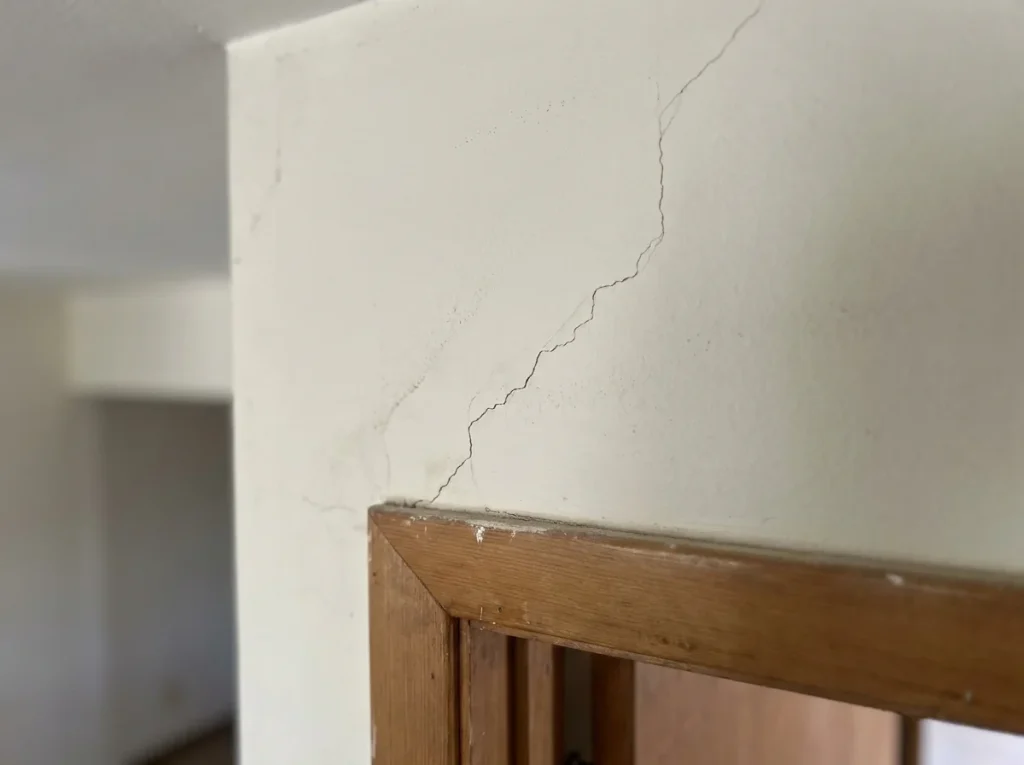
Are cracks a sign of foundation problems? Interior drywall cracks are the sign most homeowners spot first, and the ones radiating diagonally from the top corners of doorways or windows are the most telling. That corner is a stress point: as the header above the opening shifts even slightly, the drywall can’t flex, so it cracks along the shortest path.
Not every drywall crack means foundation trouble. Thin, hairline cracks that appear after a new home’s first year of settling, or ones that follow taped drywall seams in a straight line, are typically cosmetic. Cracks that are getting wider, that you can slide a fingernail into, or that keep coming back after you patch them are worth connecting to the other signs on this list.
7. Rusted or loose anchor bolts
Anchor bolts are the steel bolts that tie your home’s wood framing down to the concrete foundation, usually visible if you look along the base of a wall in a garage, crawlspace, or unfinished area. In Phoenix’s climate, these bolts can rust from moisture intrusion at cracks in the stem wall, or work loose as the foundation shifts beneath the sill plate.
A single lightly surface-rusted bolt in an older home isn’t unusual. Multiple bolts that are visibly loose, badly corroded, or missing their nuts entirely mean the connection between your house and its foundation isn’t doing its job the way it was designed to — and that’s a structural concern, not a cosmetic one. Our anchor bolt replacement page covers how this connection gets restored.
Get Your Foundation Looked At
A quick inspection tells you what is really going on beneath the surface — and we will send a written estimate.
→ Request a Written Estimate“Almost none of these seven signs mean your house is falling apart,” says James Belville of Concrete Repairman®. “Most of the time it’s one or two of them, mild, and easy to keep an eye on. The signs that actually worry me are the ones showing up together, and getting wider month over month.”
Which signs are cosmetic vs. structural
What are the signs of foundation problems, really — cosmetic wear or structural movement? The honest answer is that most homes show a little of both over time, and the difference usually comes down to three questions: Is it isolated or is it part of a pattern with other signs? Is it stable or has it changed in the last several months? And is it hairline, or wide enough to catch a fingernail or a coin?
- Usually cosmetic: a single hairline drywall crack, mild seasonal door stickiness, small gaps at trim in an older home, light surface flaking with no exposed rebar.
- Worth a professional look: stair-step cracks over 1/8 inch, a floor slope that’s worsened, spalling with visible rebar, multiple sticking doors on one side of the house, or several loose/rusted anchor bolts.
How do I know if my house has foundation issues for certain, rather than just guessing from a checklist? A written, documented foundation inspection is the only reliable way to sort a cosmetic pattern from a structural one, because it looks at the whole picture — the block, the slab, the framing, and how they relate — rather than any single crack in isolation. This is also where a residential foundation repair assessment starts: with an accurate read on what’s actually happening below the surface before anyone talks about a fix.
Frequently Asked Questions
What are the signs of foundation problems?
The most common signs are stair-step cracks in block or stem walls, doors and windows that stick or won’t latch, sloping or bouncy floors, spalling or flaking concrete on the stem wall, gaps at trim and baseboards, drywall cracks over doorways, and rusted or loose anchor bolts. One sign alone is rarely conclusive; several appearing together, or getting worse over time, is the pattern that matters most.
How do I know if my house has foundation issues?
Walk the perimeter of your home looking at the stem wall and block for cracking or spalling, check whether interior doors and windows operate smoothly, and note any sloping floors or new gaps at baseboards and ceilings. If you spot two or more of these signs, or any single one that’s clearly widening, a foundation inspection is the next step to confirm what’s going on rather than guessing from the surface.
Are cracks a sign of foundation problems?
They can be, but not every crack means foundation trouble. Thin, hairline cracks that follow drywall seams or that appeared once during a home’s first year of settling are usually cosmetic. Diagonal stair-step cracks in block, cracks wider than about 1/8 inch, or cracks that keep reopening after patching are the ones that point toward foundation movement.
Do sticking doors mean foundation problems?
Occasionally, but seasonal humidity is a more common cause of a single sticking door. It’s more likely tied to the foundation when several doors stick at once, particularly on the same side of the house, or when the sticking shows up alongside cracking, sloping floors, or gaps at the trim.
When should I call someone about these signs?
Call for an inspection when you notice more than one warning sign at the same time, when a crack or gap is visibly widening month to month, when you can see exposed rusted rebar in a spalled stem wall, or when multiple anchor bolts are loose or corroded. When in doubt, a written inspection from Concrete Repairman® is a low-friction way to get a clear answer instead of watching and wondering.
Can a house with foundation problems be fixed?
Yes, in the vast majority of cases. Full foundation replacement is rare. Most Phoenix homes with these warning signs are stabilized and repaired using targeted methods matched to the specific problem — crack injection and stabilization, stem wall rebuild, carbon fiber reinforcement, anchor bolt replacement, or slab leveling — rather than tearing out and rebuilding the foundation.
Is it illegal to sell a house with foundation issues?
No, it isn’t illegal, but Arizona sellers are generally required to disclose known material defects, including foundation problems, to buyers. Addressing the issue and getting it documented before listing tends to be far less costly than a buyer’s inspector flagging it during escrow.
How much does it usually cost to fix foundation issues?
Cost depends entirely on which of these seven signs you’re dealing with and how extensive the damage is — a single stair-step crack repair is a very different scope than a stem wall rebuild or multiple anchor bolt replacements. A written estimate following an inspection is the only accurate way to know what your specific situation involves.
Will homeowners insurance pay for foundation repair?
It depends on your policy and the cause. Most standard homeowners policies exclude gradual settling, soil movement, and normal wear, which cover many of the signs on this list, though sudden covered events like a plumbing leak that damages the foundation may be treated differently. Check your specific policy language, and keep documentation from your inspection either way.