
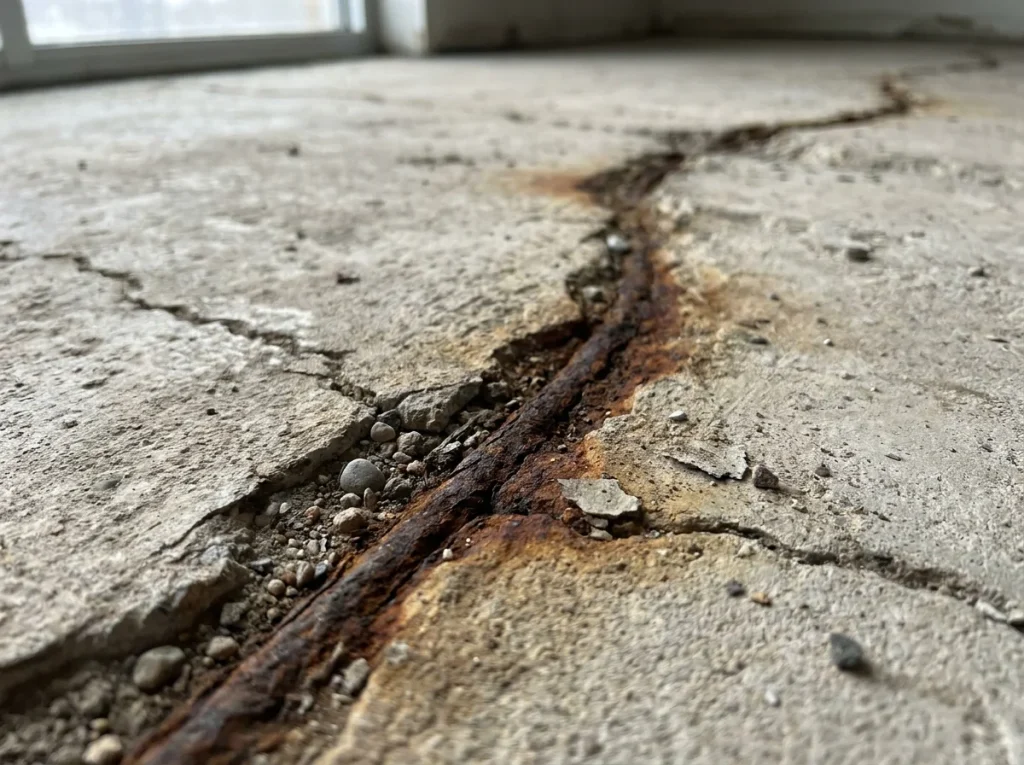
Post-tension concrete is sold as the upgrade — the slab that won’t crack like a standard foundation. So when a Phoenix homeowner finds a diagonal crack near a window or a door that suddenly won’t latch, the question is usually “wait, why do post-tension slabs fail at all?” The honest answer is that PT construction reduces cracking, but it doesn’t cancel out Arizona’s expansive clay soil, and we see the same handful of failure patterns on PT slabs across the Valley every month.
What post-tension slabs are supposed to do
A post-tension slab is poured with steel tendons running through the concrete inside plastic sheathing. Once the concrete cures, those tendons are stressed and locked off with anchors at the slab’s edges, putting the whole slab under permanent compression. Compressed concrete resists the hairline tension cracking that plagues ordinary rebar-reinforced slabs, which is why builders in the Phoenix area have leaned on PT design since the 1990s, particularly on lots with known expansive soil. If you’re not sure which type your home has, our guide to telling a standard slab from a post-tension slab walks through the visible clues.
The system works well at resisting internal cracking forces. What it was never designed to fight is the ground underneath it moving unevenly — and in the Phoenix area, that’s exactly what expansive clay does.
The Arizona failure modes
Most PT slab problems we’re called out to inspect trace back to one of three mechanisms, often working together rather than alone.
Expansive soil edge lift and center lift
Phoenix and its surrounding valleys sit on clay-heavy soils that swell when they absorb moisture and shrink hard when they dry out. When the perimeter of a slab gets more moisture than the center — from irrigation, a leaking sprinkler line, or roof runoff pooling against the foundation — the edges swell and lift relative to the middle. That’s edge lift. The reverse, center lift, happens when the interior of the slab stays moist (a broken plumbing line, poor drainage under the home) while the perimeter dries and shrinks in Arizona’s heat. Either pattern bends a slab that was engineered to sit flat under compression, and bending concrete is a different stress than the tension a PT system was built to resist. Our breakdown of why Phoenix soil wrecks foundations goes deeper into how this cycle develops over a typical summer-to-monsoon season.
Tendon corrosion and breaks
The steel tendons inside a PT slab are supposed to stay sealed inside their plastic sheathing for the life of the house. Corrosion sets in when that sheathing is compromised — a construction defect, a drilled anchor bolt that nicked a cable, or years of moisture intrusion at an anchor pocket. A corroded tendon loses strength gradually; a fully broken one can release with a loud bang and a sudden loss of tension in that section of slab. Anchorage and dead-end failures are a related cause: the stressing anchors at the slab edge are a known weak point, and a failed anchor can un-tension an entire cable run even if the cable itself is sound.
Differential settlement
Even a well-tensioned slab isn’t immune to differential settlement — one section of the foundation settling lower than the rest because of soil consolidation, poor original compaction, or a plumbing leak washing out material under the slab. PT tendons resist cracking from lateral stress, but they don’t stop vertical movement when the soil supporting one part of the slab simply gives way.
“A lot of what people call a ‘post-tension failure’ is really the soil talking through the slab — the concrete is just where you see it first.”
How you’d notice
PT slab problems tend to show up the same way any foundation problem does, just sometimes later and with different crack geometry:
Get Your Foundation Looked At
A quick inspection tells you what is really going on beneath the surface — and we will send a written estimate.
→ Request a Written Estimate- Diagonal cracks radiating from the corners of doors and windows
- Doors and cabinets that stick or won’t latch, especially ones that used to work fine
- Sloping or bouncy spots in the floor, particularly near exterior walls
- A crack running the length of the slab edge, or gaps opening between the slab and a patio or driveway
- A popping or banging sound from under the floor, which can indicate a tendon has broken
- Visible spalling or rust staining near an anchor pocket at the slab edge
None of these on their own confirm a tendon failure versus a plain soil-movement crack — that distinction matters because the fix is different, which is why diagnosis comes before any repair proposal.
How PT slab problems are diagnosed and repaired
Because a live, tensioned cable is dangerous to cut into blind, we start with a foundation inspection that includes locating tendons with ground-penetrating radar before any drilling near an anchor or a suspected break — cutting a tensioned cable without knowing exactly where it runs is not something to guess at. From there, the repair path depends on what’s actually driving the movement. If the cause is soil moisture imbalance, correcting drainage, grading, and irrigation habits around the perimeter often stops the movement before further structural work is needed. If cracking is tied to settlement or differential movement, options range from carbon fiber reinforcement for stabilizing cracked sections to more targeted post-tension slab repair addressing the affected tendon run or anchorage. We’ve handled this exact diagnosis-first process on PT foundations across the Phoenix area.
Frequently Asked Questions
Why do post-tension slabs fail?
They fail — or appear to fail — mainly from expansive clay soil movement (edge lift or center lift), tendon corrosion or anchorage failure, and differential settlement. PT construction resists internal tension cracking well, but it can’t stop the ground underneath from swelling, shrinking, or settling unevenly.
Do post-tension slabs crack?
Yes. PT slabs crack less than standard rebar slabs because the concrete stays under compression, but cracking still happens when soil movement, settlement, or a tendon issue overwhelms that compression. A crack on a PT slab is worth having looked at rather than assumed to be cosmetic.
Can a post-tension slab be repaired?
Yes. Depending on the cause, repair can involve correcting the drainage or moisture issue driving soil movement, carbon fiber reinforcement to stabilize cracked areas, or repair work at the affected tendon or anchorage. The right approach follows the diagnosis, not the other way around.
How do you know if a post-tension cable is broken?
A sudden loud bang from inside the slab, a new crack appearing quickly rather than gradually, or a section of floor that suddenly feels different underfoot can all point to a broken or released tendon. Ground-penetrating radar locates the tendon layout so a suspected break can be confirmed without cutting into the slab blind.
Are post-tension foundations good in Arizona?
Post-tension is generally a strong choice for Arizona’s expansive soils and is why many Valley builders use it, but “good” doesn’t mean immune to movement. A PT slab still needs the same drainage management, grading, and periodic inspection that any Phoenix foundation needs — it just starts from a stronger baseline against ordinary cracking.