If a contractor has ever told you your yard has “caliche,” they weren’t talking about ordinary dirt. Caliche is a cemented, rock-hard soil layer that sits under much of the Phoenix Valley, and it changes how water moves, how footings get dug, and how a slab settles over time. Homes across Arizona deal with it constantly.
Caliche, defined
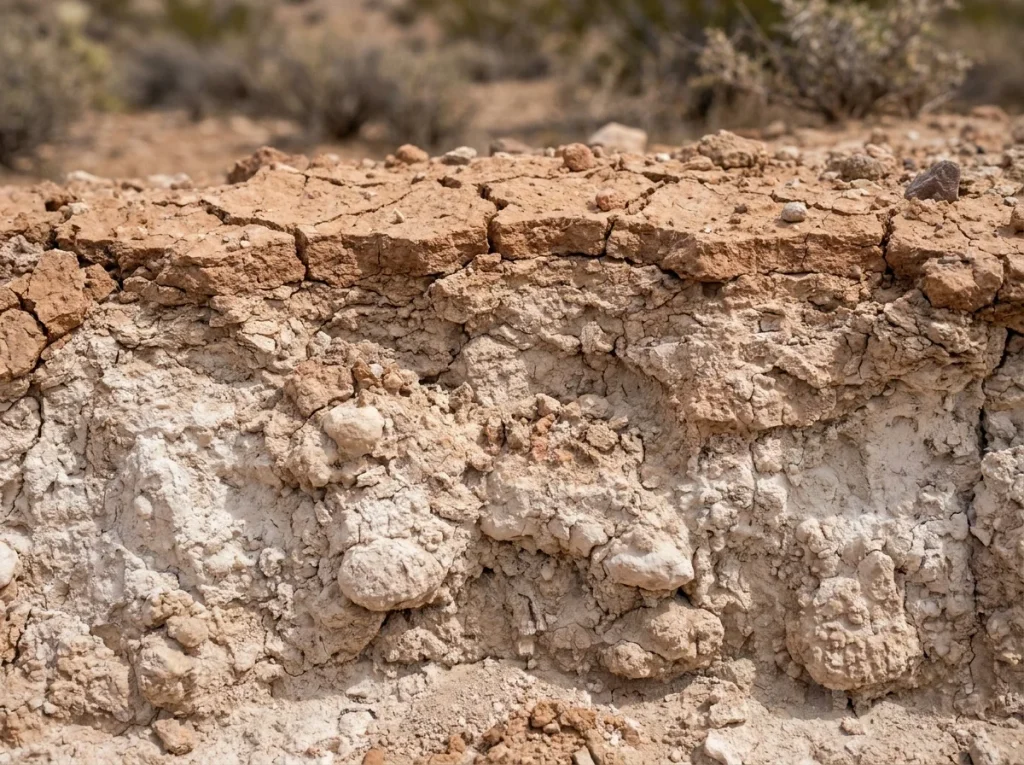
Caliche is a hardpan layer formed when calcium carbonate — essentially dissolved limestone — cements sand, gravel, and clay particles together into a dense, concrete-like mass. It isn’t a type of soil so much as a soil that has been welded shut. Caliche can range from a thin crust a few inches down to a layer several feet thick, and in parts of the Phoenix area it sits close enough to the surface to interfere directly with footings, slabs, and drainage systems.
Homeowners usually meet caliche for the first time when they try to plant a tree, dig a fence post hole, or install a new drain line and hit what feels like a layer of concrete a foot or two down. That reaction is the right one — caliche behaves more like a weak, brittle rock than like soil, which is exactly why it matters to a house sitting on top of it.
Why it forms in the desert
Caliche is a signature of arid and semi-arid climates, and the Sonoran Desert produces textbook conditions for it. Rainfall here is limited and infrequent, so water rarely percolates deep enough to flush minerals out of the soil profile. Instead, water soaks in a short distance, evaporates in the heat, and leaves calcium carbonate behind. Over thousands of years, that residue accumulates and cements the surrounding soil particles into hardpan.
This is a slow, geologic process, which means the caliche under a Phoenix subdivision predates the subdivision by a wide margin. Builders don’t create it and can’t easily remove it across an entire site — they build around it, over it, or occasionally have to break through it, and each of those choices has consequences for the foundation above.
How caliche traps water and hurts drainage
The biggest problem caliche creates isn’t its hardness — it’s what that hardness does to water. Because caliche is far less permeable than the soil above it, water that would normally drain downward instead hits the hardpan layer and spreads out sideways, or simply pools on top of it. Engineers call this a “perched water table,” and it’s a well-documented driver of foundation trouble in the Valley.
Combine that with Phoenix’s climate pattern — long dry stretches followed by intense monsoon downpours — and the effect compounds. Dry desert clay above the caliche shrinks and cracks during the heat of summer, then a monsoon storm dumps water that can’t escape downward through the hardpan below. The soil directly under a slab or footing swells unevenly, and poor site drainage makes the problem worse. It’s one reason grading and drainage come up so often in conversations about sinking foundation repair in this region — caliche is frequently the hidden reason water isn’t going where it should.
Caliche doesn’t cause foundation damage by itself — it causes foundation damage by trapping water where a house needs it to drain away.
Differential movement above a hardpan layer
Foundations rarely fail because the whole slab moves together; they fail because parts of it move differently than others. That’s called differential movement, and a caliche layer is a near-perfect setup for it. Because caliche doesn’t form as a perfectly flat, uniform sheet, its depth varies across a single lot — shallow in one corner, several feet down in another. Water perches unevenly on top of those variations, so the soil beneath one section of a foundation can be saturated and expanded while soil beneath another section stays dry and firm.
The result shows up as cracked stem walls, stair-step cracks in block, doors and windows that stick, and slabs that tilt toward one edge of the house. This is the same mechanism behind much of what gets diagnosed as foundation crack repair and foundation settlement repair work across Phoenix — the visible crack is downstream of an invisible soil layer doing something inconsistent underneath it.
Get Your Foundation Looked At
A quick inspection tells you what is really going on beneath the surface — and we will send a written estimate.
→ Request a Written EstimateWhy it makes footings and piers harder to install
Caliche’s density is also a construction problem in its own right. Standard excavation equipment that moves easily through native desert soil can slow to a crawl — or stop outright — when it hits a thick caliche band. Contractors sometimes need specialized equipment, longer excavation timelines, or in the toughest cases, pneumatic hammers to break through hardpan for footings, utility trenches, or deep foundation elements like piers.
That difficulty is exactly why caliche gets discussed so often alongside deep foundation methods, including helical and push piers, which are an industry-wide approach some contractors use to reach load-bearing soil below a hardpan layer. We don’t install piers or perform underpinning; our focus is on repairing the damage caliche and expansive clay actually cause — crack repair, carbon fiber reinforcement, concrete leveling, and stem wall repair — restoring what’s above the soil rather than reaching below it.
Because caliche interacts directly with the expansive clay that sits above and around it in much of the Valley, the two conditions are usually discussed together, not separately. Clay swells and shrinks with moisture; caliche decides where that moisture goes and how long it stays. For a broader look at how the region’s soil profile drives cracking, settlement, and uneven floors, see our overview of Phoenix foundation repair and the related read on why Phoenix soil wrecks foundations.
Frequently Asked Questions
What is caliche?
Caliche is a hardpan soil layer formed when calcium carbonate cements sand, gravel, and clay together into a dense, rock-like mass. It’s common throughout arid regions, including the Phoenix Valley, and can range from a thin crust to several feet thick.
Is caliche bad for foundations?
Caliche itself isn’t inherently destructive, but its effects on drainage and soil behavior are. By trapping water and creating uneven moisture conditions in the soil above it, caliche contributes to differential movement, which is a leading cause of foundation cracking and settlement in Phoenix homes.
Does caliche cause drainage problems?
Yes. Because caliche is far less permeable than the soil above it, water that would normally drain downward instead perches on top of the hardpan layer or spreads laterally. This is one of the most common drainage issues affecting foundations built over caliche in Arizona.
Can you dig through caliche for piers?
Contractors can excavate through caliche for deep foundation elements, including piers, but it typically requires heavier equipment and more time than digging through native desert soil. Thickness and depth vary significantly by lot, which is why a site-specific soil assessment matters before any excavation work begins.
How do you deal with caliche under a house?
Dealing with caliche starts with understanding where it sits relative to your foundation and how it’s affecting drainage and soil movement around the home. From there, the right response depends on what the caliche has already caused — whether that’s cracking, settlement, or uneven floors — which is best confirmed with a professional foundation inspection rather than guesswork.