
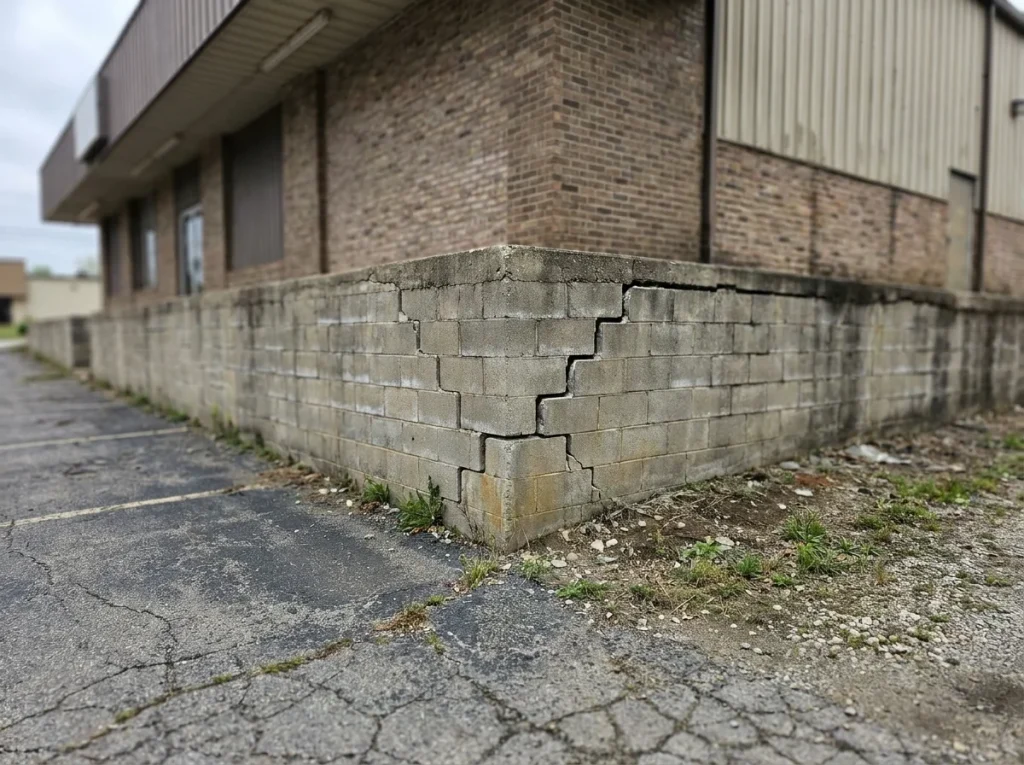
Commercial foundation repair in Phoenix, Arizona typically runs $10,000 to $100,000 or more, and that enormous spread is what trips up most property managers trying to pencil out a budget number. The honest answer is that your price depends far less on square footage than on pier count, engineering requirements, and how fast the job has to move without shutting your doors. Here’s what actually drives the number, and how it differs by building type.
Why commercial ranges are so wide ($10k–$100k+)
Search “foundation repair cost” and you’ll find national averages hovering around $5,200, with most homeowners paying somewhere between $2,200 and $8,100. Those figures are useful for a single-family slab with one settled corner — they mean almost nothing for a commercial building. A 40,000-square-foot warehouse with a loading dock, a multi-tenant retail strip, or an HOA clubhouse carries structural load, code requirements, and access constraints a residential job never sees. That’s why commercial estimates aren’t quoted as a flat per-square-foot rate; they’re scoped project by project on the commercial foundation repair side of the business, after an inspection identifies exactly what’s moving and why.
What drives the price
Building size & number of piers
Pier count is usually the single biggest line item on a large-scale stabilization job — more piers mean more drilling, more material, and more labor hours, and a bigger footprint often means more settlement points to address at once. A small strip-mall unit might need repair concentrated on one wall; a full warehouse slab or a multi-building HOA complex can require work spread across dozens of points, which is where costs climb toward the upper end of the range.
Method (piers vs. slab vs. post-tension)
Different failure modes call for different fixes, and the method drives cost as much as scale does. Deep structural underpinning with helical or push piers is an industry-standard approach for severe, deep-seated settlement — it’s equipment- and labor-intensive, which pushes it toward the higher end of commercial budgets. For less severe or more localized movement, options like post-tension slab repair, carbon fiber wall stabilization, or targeted crack and stem-wall repair are typically far less disruptive and less expensive. We scope stem wall repair, crack repair, carbon fiber reinforcement, post-tension and slab repair, concrete leveling, and settlement diagnostics for Phoenix-area commercial properties — the inspection determines which category your building actually falls into before any number gets attached to it.
Engineering, permits & documentation
Commercial jobs almost always require a structural engineer’s report, stamped drawings, and a permit pulled through the local jurisdiction before repair work can start. That documentation isn’t optional paperwork — it protects the property owner, satisfies insurers and lenders, and is often required before a tenant lease or a property sale can close. Budget for this as a real line item, not an afterthought; it’s a meaningful part of why a commercial number lands higher than a homeowner’s quote for what looks like a similar-sized repair.
After-hours / minimal-disruption scheduling
A retail tenant that can’t close during business hours, a warehouse that can’t pause receiving, or a medical office that can’t have drilling noise during patient hours all need work scheduled around operations rather than around the crew’s convenience. Night, weekend, and phased scheduling carries a real cost premium, but for most commercial owners it’s cheaper than the revenue lost to a full shutdown — which is exactly the tradeoff worth discussing before the estimate is finalized.
Repair methods and what they cost relative to each other
Roughly speaking, targeted crack repair and stem wall repair sit at the lower end of the commercial spectrum since they address localized damage without major excavation. Concrete leveling and slab stabilization for moderate settlement fall in the middle. Carbon fiber reinforcement and post-tension repair land in a similar mid-to-upper range depending on the extent of the affected slab or wall area. Deep pier-driven underpinning — an industry method used for severe structural settlement — typically represents the top of the range because of the equipment, drilling depth, and labor involved. The right method isn’t a matter of preference; it’s dictated by what the engineering report finds underneath the building.
The hidden cost: operational downtime
The repair invoice is rarely the biggest number in the equation. A retail center that loses foot traffic during construction, a warehouse that can’t process orders, an office building with restricted tenant access, or an HOA facing special-assessment friction with residents — all of that operational disruption compounds the direct repair cost. This is why minimal-disruption scheduling isn’t a luxury add-on for commercial clients; it’s usually the difference between a repair that pays for itself quickly and one that drags on the P&L long after the concrete has cured.
On a commercial job, the concrete itself is rarely what makes the estimate expensive — the engineering, the permitting, and the schedule built around a live business almost always are.
Not Sure How Bad It Is?Get Your Foundation Looked At
A quick inspection tells you what is really going on beneath the surface — and we will send a written estimate.
→ Request a Written Estimate
How we scope a commercial estimate
Every commercial estimate starts with a site assessment, not a guess over the phone. We bring hands-on foundation repair experience to a foundation inspection that documents the actual movement, cross-references it against engineering standards, and maps out which method fits the building — before any number is committed to paper. That evidence-based approach is what commercial buyers should expect from a contractor bidding structural work: a written estimate tied to a documented diagnosis, not a rough number pulled from square footage alone. For retail, office, warehouse, multi-family, or HOA properties in the Phoenix area, the next step is a scoped site assessment. Contact us to book an inspection and get a written estimate for your building.
Frequently Asked Questions
How much does commercial foundation repair cost?
Most commercial jobs in the Phoenix area range from about $10,000 for a limited, localized repair up to $100,000 or more for large-scale stabilization involving many piers, engineering, and permitting. The final number depends on building size, the number of settlement points, the repair method required, and whether after-hours scheduling is needed.
What methods are used for commercial foundation repair?
Depending on what the inspection finds, commercial repairs can involve stem wall repair, foundation crack repair, carbon fiber reinforcement, concrete leveling, post-tension slab repair, or deep pier-driven underpinning for severe structural settlement. The engineering report determines which method — or combination of methods — actually fits the building’s failure pattern.
What are the signs of commercial building settlement?
Watch for diagonal cracks radiating from door and window corners, doors or overhead bays that stick or won’t latch, uneven or sloping floors, cracks in the slab or tilt-up panels, and separation where walls meet the foundation. Any of these on a commercial property warrants a structural inspection rather than a wait-and-see approach, since commercial settlement tends to progress under continuous structural load.
Will repair disrupt my business operations?
It can, but disruption is manageable with the right scheduling. Phased work, night and weekend crews, and sequencing around tenant hours or loading schedules all reduce the operational hit — at a scheduling premium that’s usually far less costly than a full shutdown. This is something to negotiate into the estimate up front, not after the crew has already mobilized.
Do commercial jobs require an engineer and permits?
Almost always, yes. Commercial foundation repair typically requires a structural engineer’s evaluation, stamped drawings, and a permit from the local jurisdiction before work begins. Lenders, insurers, and future buyers or tenants generally expect this documentation on file, which is part of why commercial estimates run higher than a comparable residential repair.
How long does commercial foundation repair take?
Timelines vary widely with scope — a limited crack or stem wall repair might wrap in a few days, while a large-scale pier or post-tension project spanning a warehouse or multi-building complex can take several weeks once engineering, permitting, and phased scheduling are factored in. The written estimate from a site assessment will include a realistic project timeline specific to your building.