
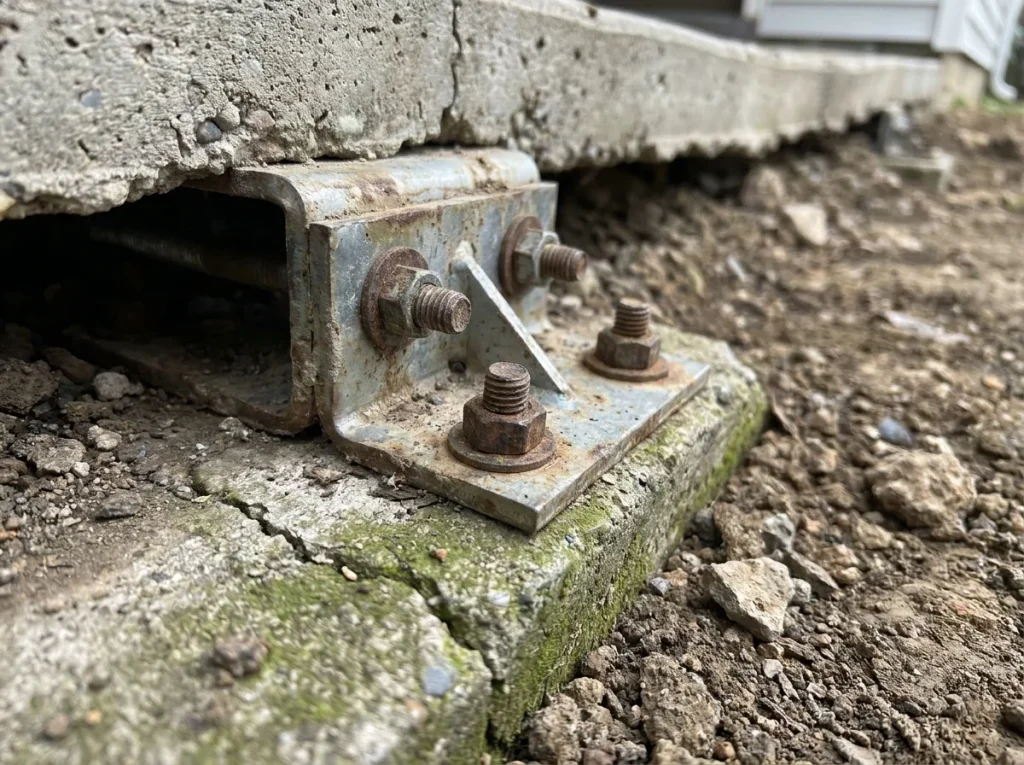
Yes — in most cases a sinking foundation can be lifted, but the honest answer for Phoenix, Arizona homeowners is more nuanced than “we’ll get it back to perfectly level.” When a slab or stem wall settles, the affected section can typically be raised and stabilized. The real question isn’t whether a lift is possible — it’s how much recovery is realistic, and whether chasing a dead-level floor is worth the risk to your drywall, tile, and stucco.
The honest answer — often, but “stabilize” matters more than “perfect level”
Most sinking foundations can be lifted to some degree. What varies is how much. A slab that has settled a half inch over a few years of expansive-clay movement will usually respond well to leveling work. A home that has settled two or three inches unevenly, over decades, with differential movement from one corner to the other, may only recover a portion of that drop before the structure itself resists further lift. Stabilizing the foundation — stopping further movement and closing the gap — is almost always achievable. Restoring the exact elevation the house had the day it was built is not always achievable, and any contractor who promises a guaranteed full recovery on a severely settled slab is setting you up for disappointment, or worse, cracked finishes.
This is the trade-off sinking foundation repair is built around in the Phoenix area: enough lift to close cracks, level floors within a reasonable tolerance, and stop the movement — without over-forcing a slab that has settled into a new equilibrium.
How lifting works (piers and slab jacking)
There are two broad families of lifting method used in the foundation repair industry, and it helps to understand both before you decide what your home actually needs.
Piers and underpinning are the industry-standard method for lifting and permanently supporting a perimeter foundation. Steel piers are driven or screwed into deeper, more stable soil beneath the footing, then used to transfer the structure’s weight off the unstable soil layer that caused the settlement in the first place. It’s a legitimate, widely used technique for severe structural settlement — but it’s a significant undertaking, and it isn’t the right tool for every sinking-foundation problem, especially where the issue is soil moisture cycling rather than deep structural failure.
Slab jacking — sometimes called mudjacking or foam leveling — addresses a different problem: an interior slab or a section of flatwork that has settled or hollowed out beneath the surface. A lightweight polyurethane foam or cementitious grout is injected beneath the slab, filling voids and gently raising the surface back toward level. This is the approach behind our concrete leveling service, and for Phoenix homes where settlement is a slab or walkway issue rather than a foundation-wide structural failure, it’s often the faster, less invasive path to a level, usable floor.
For sinking foundations that need more than surface leveling, we build a stabilization plan around crack repair, carbon fiber reinforcement, and anchor bolt replacement where connections have failed — targeting the specific damage the settlement caused rather than defaulting to the most invasive option available.
How much recovery is realistic
Not every crack or dip is an emergency, and not every settled foundation needs aggressive lifting. Here’s how the industry generally measures it:
- A uniform settlement of about 1/4 to 1/2 inch across a slab is considered normal and rarely needs lifting on its own.
- Differential settlement — where one section drops more than another — is the real concern, because it’s what actually stresses framing, drywall, and finishes.
- A common industry rule of thumb: more than 1 inch of drop over a 20-foot span (or a slope greater than 1/4 inch over 10 feet) is generally considered excessive and worth a professional look.
- New Phoenix-area homes commonly settle 1 to 2 inches in their first two to three years as the soil consolidates under the new structural load — this is expected, not a defect.
- Cracks matter, too: hairline cracks under 1/16 inch are typically cosmetic, while cracks wider than 1/4 inch, horizontal cracks, or stair-step cracking in block or brick are signs that warrant an inspection.
These are general guidelines, not a diagnosis — the only way to know how much lift your specific home realistically needs is a hands-on look at the elevation profile, the soil, and the pattern of the damage.
The risk of chasing a perfectly level result
It’s tempting to want the “before” elevation back exactly. But a foundation that has already settled has usually done some of its cracking and shifting already — walls have flexed, drywall seams have adjusted, door frames have racked slightly. Pushing a slab or wall back up past the point where those finishes have already settled into their new position can create brand-new cracks rather than closing the old ones. Over-lifting can also stress plumbing lines that have flexed to accommodate the settled position, turning a foundation fix into a plumbing problem.
The goal isn’t a laser-level floor at any cost — it’s a stable, safe foundation with damage repaired and finishes intact.
Not Sure How Bad It Is?Get Your Foundation Looked At
A quick inspection tells you what is really going on beneath the surface — and we will send a written estimate.
→ Request a Written Estimate
A contractor focused on the right outcome will typically aim for enough lift to close structural gaps and bring floors within a reasonable, walkable tolerance — not necessarily dead-flat. That’s the difference between a repair that lasts and one that trades one set of cracks for another.
Why we fix the cause before lifting
Lifting a foundation without addressing why it sank in the first place is a temporary fix. In the Phoenix area, that usually means a moisture problem: expansive clay soils that swell when wet and shrink when dry, poor drainage directing water toward the footing, a leaking irrigation line, or a downspout dumping water against the slab edge year after year. Settlement (the foundation moving down, typically from soil compression, erosion, or drying) and heave (the foundation moving up, typically from expansive clay swelling with added moisture) are the two opposite pressures that shape most Valley foundation problems, and treating one without understanding which is at play can make things worse.
That’s why a proper repair sequence starts with a foundation inspection to identify the actual cause — grading, drainage, plumbing leaks, soil type — before any lifting or leveling begins. We back our stabilization and leveling work with a warranty, because the goal is a repair that holds, not one that needs revisiting in five years because the underlying moisture source was never addressed.
Frequently Asked Questions
Can a sinking foundation be lifted back to level?
Often, yes — at least partially. Most sinking foundations can be stabilized and raised to a meaningful degree, closing gaps and leveling floors within a reasonable tolerance. A full return to the original, exact elevation is realistic on milder settlement but less certain on severe, long-term differential settlement, where the priority shifts to stopping movement and repairing damage safely rather than forcing a perfect result.
How do you lift a settled foundation?
It depends on what settled. Perimeter foundation walls with deep structural settlement are typically addressed with piers or underpinning, an industry technique that transfers the load to more stable soil. Interior slabs, walkways, or sections that have settled or voided out underneath are usually leveled with slab jacking — injecting foam or grout beneath the surface to raise it back toward level. Related structural damage, like cracked walls or failed anchor bolts, is repaired separately as part of the same stabilization plan.
Will lifting crack my walls?
It can, if the lift is pushed too far or done without a plan for the existing cracks. Finishes that have already flexed to accommodate settled framing can crack again if forced back past the point they’ve settled into. That’s why the goal in a well-run lift is closing gaps and restoring reasonable level, not maximum possible elevation, and why crack repair is planned alongside — not after — the lifting work.
Is it better to stabilize or fully re-level?
For most Phoenix homes with moderate settlement, stabilizing the foundation and achieving a reasonable, safe level is the better goal than chasing a perfectly re-leveled slab. Full re-leveling carries more risk to finishes and plumbing, and the marginal benefit rarely outweighs that risk once the foundation is stable and functional. Severe cases are the exception, where a licensed structural engineer’s evaluation should guide how much lift is appropriate.
How long does a foundation lift last?
A lift that addresses the underlying cause — drainage, soil moisture, a leaking line — can last for many years, backed by a warranty on the completed work. A lift performed without correcting the cause tends to be temporary, since the same soil movement that caused the original settlement will likely cause it again. That’s why cause identification during the inspection stage matters as much as the lifting technique itself. For homeowners weighing pier depth and long-term stability further, see our related breakdown of how deep piers are typically driven in Arizona soil.